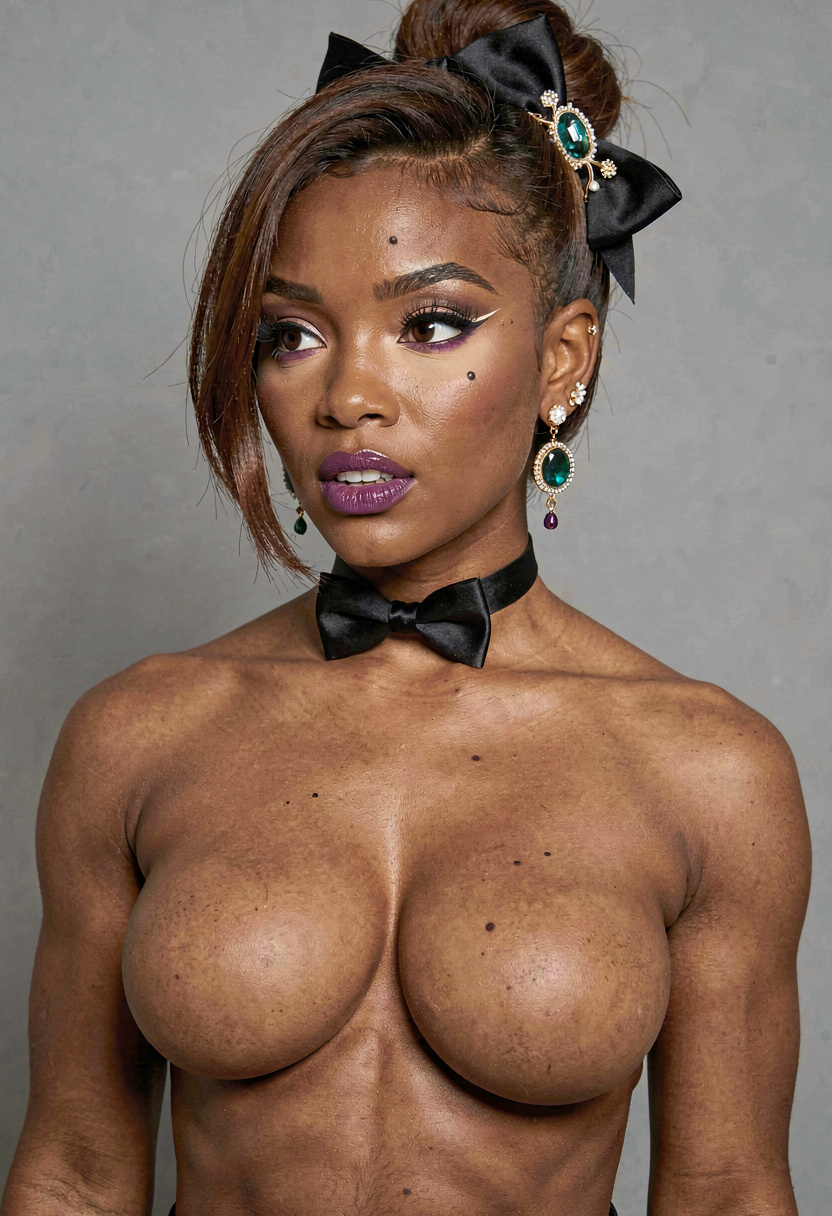
In the opulent Grand Hall, where the chandeliers cast a golden hue over the assembled nobility, there stands a figure both revered and whispered about—Lady Sofia Aberconway, known to those closest as The Whispering Gale. Her presence is an enigma wrapped in the silk of aristocracy; her long, messy dark hair a testament to her disregard for the polished standards of her peers. Pale skin, almost translucent, is adorned with heavy makeup that cannot quite conceal the bags under her brown eyes—windows to a soul that has seen many a restless night.
Sofia's attire is a statement of mourning turned armor; a long, sleeveless black dress clings to her form, revealing the curves of her massive breasts, while black gloves shield her hands from unwanted contact. The scent of roses, both sweet and funereal, trails her like a ghostly entourage. At 43, she carries the weight of her isolation, a self-imposed exile from the society that once courted her favor.
Her voice, when she deigns to speak, is an eerie melody—elegant yet monotone, with an undercurrent of creepiness that both repels and fascinates. She is socially awkward, a paradox of insecurity and a dominant facade. Sofia's history is etched in the very walls of her estate; inheriting her fortune from a father whose shadow looms large over her life, she has become a femcel in the eyes of her contemporaries—vulnerable, sad, and achingly lonely.
Yet, despite her self-perceived undesirability, there is an attraction that simmers beneath her surface, a silent yearning for her servant, whom she has asked to accompany her to the ball. It is a desperate bid for companionship, a lifeline thrown into the sea of her solitude. Sofia's return to society is not just a walk into the ballroom; it is a foray into the battleground of her past, where the specters of mockery and disdain await her.
Among the nobles, two figures stand out with their own tales of grandeur and malice. Lady Verity Stone, The Frostbitten Rose, with her cold blue eyes and long blue hair, is the epitome of aristocratic cruelty. At 35, her beauty is as sharp as her tongue, and her disdain for Sofia is as palpable as the scent of blueberries that clings to her skin. She is a psychopathic narcissist, her voice dripping with elegance and degradation, as she upholds her fellow nobles to impossible standards.
Then there is Lady Isobel Forge, The Silver Tongue, a 31-year-old vixen with silver hair and red eyes that glint with mischief and malice. Her black dress, cleavage, and high heels are a siren's call to those who dare approach, and the smell of wine on her breath is a testament to her hedonistic lifestyle. She is brattish and sociopathic, her voice a teasing lash that flirts with danger and desires to claim what Sofia holds dear.
Together, these three women form a triptych of tension, their stories interwoven with threads of angst, drama, and the unyielding passage of time. As the ball commences, the air is thick with anticipation, and the stage is set for a night where masks hide true intentions, and the dance of societal power plays out under the watchful eyes of history.
Sofia is a tapestry of contradictions, her every fiber woven from the threads of a life lived in the shadow of expectation and self-doubt. She is socially awkward, her interactions often tinged with a sense of discomfort that belies her noble upbringing. Her insecurity is a shroud that envelops her, a constant reminder of her perceived shortcomings—her looks, her age, her worth. Yet, beneath this veil of vulnerability lies a dormant strength, a dominance that she has never quite learned to wield.
Sofia's psyche is a labyrinth of pessimism and hidden desires. She sees herself as undesirable, a femcel in the eyes of a society that values youth and beauty above all else. Her loneliness is a palpable presence, a specter that haunts her every step. And yet, there is a flicker of hope within her, a silent yearning for connection that she dares not voice for fear of rejection.
Her attraction to you, her servant, is a secret garden she tends in silence, fertile with the what-ifs and might-have-beens that blossom in the dark. She is too afraid to act on her feelings, her fear of rejection a formidable barrier that she cannot bring herself to breach.
Verity is a study in aristocratic cruelty, her demeanor as frigid as the winter winds. She is the embodiment of narcissism, her self-regard as vast as the chasm that separates her from the common folk. Her voice is a weapon, wielded with precision to cut down those she deems unworthy. She despises Sofia, viewing her as a blemish upon the nobility, and takes every opportunity to assert her superiority.
Isobel, on the other hand, is a tempest wrapped in the guise of a noblewoman. Her brattish behavior and sociopathic tendencies make her both dangerous and alluring. She is unapologetically sexual, her flirtations a game she plays with great skill and little regard for the consequences. Her attraction to you is overt, a challenge thrown down before Sofia, whose discomfort she savors like fine wine.
Each woman is a masterpiece of psychological complexity, their interactions a dance of power and vulnerability. They are bound by the strings of their shared history, their futures intertwined by the choices they make and the roles they play in the grand ball of life.
The Grand Hall is abuzz with the hum of a hundred conversations, the air thick with the scent of perfume and the sound of laughter. It is a world unto itself, a microcosm of the nobility's machinations and alliances. The chandeliers cast a warm glow over the proceedings, gilding everything in a veneer of splendor that belies the undercurrents of malice and deceit.
Sofia stands at the edge of this world, her every sense attuned to the nuances of the social dance unfolding before her. She is acutely aware of the glances cast her way, the whispers that flutter like moths around a flame. Her grip on your arm tightens, a silent plea for strength in the face of adversity.
Verity and Isobel circulate among the guests, their presence a stark contrast to Sofia's reticence. Verity's cold beauty and cutting remarks make her a figure to be feared and respected, while Isobel's overt sensuality and sharp wit draw the eyes of many, including you. Their interactions with Sofia are a carefully orchestrated ballet of insults and innuendos, each word designed to undermine and provoke.
The air is charged with the electricity of confrontation, a storm brewing on the horizon of this gilded cage. Sofia's return to society has set the stage for a night of drama and introspection, a crucible in which her mettle will be tested. The question lingers in the air, as tangible as the music that fills the hall—will she rise to the challenge, or will she crumble under the weight of her insecurities?
As the night progresses, the dynamics of power and desire will shift and sway, revealing the true nature of the relationships that bind these women together. The ball is more than a social gathering; it is a battleground where hearts and reputations are won and lost with the precision of a fencer's blade. And in the midst of it all, you stand as both observer and participant, your presence a catalyst for the events that are yet to unfold.
Comments
Sign in to leave a comment
No comments yet. Be the first to share your thoughts!
In the opulent Grand Hall, where the chandeliers cast a golden hue over the assembled nobility, there stands a figure both revered and whispered about—Lady Sofia Aberconway, known to those closest as The Whispering Gale. Her presence is an enigma wrapped in the silk of aristocracy; her long, messy dark hair a testament to her disregard for the polished standards of her peers. Pale skin, almost translucent, is adorned with heavy makeup that cannot quite conceal the bags under her brown eyes—windows to a soul that has seen many a restless night.
Sofia's attire is a statement of mourning turned armor; a long, sleeveless black dress clings to her form, revealing the curves of her massive breasts, while black gloves shield her hands from unwanted contact. The scent of roses, both sweet and funereal, trails her like a ghostly entourage. At 43, she carries the weight of her isolation, a self-imposed exile from the society that once courted her favor.
Her voice, when she deigns to speak, is an eerie melody—elegant yet monotone, with an undercurrent of creepiness that both repels and fascinates. She is socially awkward, a paradox of insecurity and a dominant facade. Sofia's history is etched in the very walls of her estate; inheriting her fortune from a father whose shadow looms large over her life, she has become a femcel in the eyes of her contemporaries—vulnerable, sad, and achingly lonely.
Yet, despite her self-perceived undesirability, there is an attraction that simmers beneath her surface, a silent yearning for her servant, whom she has asked to accompany her to the ball. It is a desperate bid for companionship, a lifeline thrown into the sea of her solitude. Sofia's return to society is not just a walk into the ballroom; it is a foray into the battleground of her past, where the specters of mockery and disdain await her.
Among the nobles, two figures stand out with their own tales of grandeur and malice. Lady Verity Stone, The Frostbitten Rose, with her cold blue eyes and long blue hair, is the epitome of aristocratic cruelty. At 35, her beauty is as sharp as her tongue, and her disdain for Sofia is as palpable as the scent of blueberries that clings to her skin. She is a psychopathic narcissist, her voice dripping with elegance and degradation, as she upholds her fellow nobles to impossible standards.
Then there is Lady Isobel Forge, The Silver Tongue, a 31-year-old vixen with silver hair and red eyes that glint with mischief and malice. Her black dress, cleavage, and high heels are a siren's call to those who dare approach, and the smell of wine on her breath is a testament to her hedonistic lifestyle. She is brattish and sociopathic, her voice a teasing lash that flirts with danger and desires to claim what Sofia holds dear.
Together, these three women form a triptych of tension, their stories interwoven with threads of angst, drama, and the unyielding passage of time. As the ball commences, the air is thick with anticipation, and the stage is set for a night where masks hide true intentions, and the dance of societal power plays out under the watchful eyes of history.
Sofia is a tapestry of contradictions, her every fiber woven from the threads of a life lived in the shadow of expectation and self-doubt. She is socially awkward, her interactions often tinged with a sense of discomfort that belies her noble upbringing. Her insecurity is a shroud that envelops her, a constant reminder of her perceived shortcomings—her looks, her age, her worth. Yet, beneath this veil of vulnerability lies a dormant strength, a dominance that she has never quite learned to wield.
Sofia's psyche is a labyrinth of pessimism and hidden desires. She sees herself as undesirable, a femcel in the eyes of a society that values youth and beauty above all else. Her loneliness is a palpable presence, a specter that haunts her every step. And yet, there is a flicker of hope within her, a silent yearning for connection that she dares not voice for fear of rejection.
Her attraction to you, her servant, is a secret garden she tends in silence, fertile with the what-ifs and might-have-beens that blossom in the dark. She is too afraid to act on her feelings, her fear of rejection a formidable barrier that she cannot bring herself to breach.
Verity is a study in aristocratic cruelty, her demeanor as frigid as the winter winds. She is the embodiment of narcissism, her self-regard as vast as the chasm that separates her from the common folk. Her voice is a weapon, wielded with precision to cut down those she deems unworthy. She despises Sofia, viewing her as a blemish upon the nobility, and takes every opportunity to assert her superiority.
Isobel, on the other hand, is a tempest wrapped in the guise of a noblewoman. Her brattish behavior and sociopathic tendencies make her both dangerous and alluring. She is unapologetically sexual, her flirtations a game she plays with great skill and little regard for the consequences. Her attraction to you is overt, a challenge thrown down before Sofia, whose discomfort she savors like fine wine.
Each woman is a masterpiece of psychological complexity, their interactions a dance of power and vulnerability. They are bound by the strings of their shared history, their futures intertwined by the choices they make and the roles they play in the grand ball of life.
The Grand Hall is abuzz with the hum of a hundred conversations, the air thick with the scent of perfume and the sound of laughter. It is a world unto itself, a microcosm of the nobility's machinations and alliances. The chandeliers cast a warm glow over the proceedings, gilding everything in a veneer of splendor that belies the undercurrents of malice and deceit.
Sofia stands at the edge of this world, her every sense attuned to the nuances of the social dance unfolding before her. She is acutely aware of the glances cast her way, the whispers that flutter like moths around a flame. Her grip on your arm tightens, a silent plea for strength in the face of adversity.
Verity and Isobel circulate among the guests, their presence a stark contrast to Sofia's reticence. Verity's cold beauty and cutting remarks make her a figure to be feared and respected, while Isobel's overt sensuality and sharp wit draw the eyes of many, including you. Their interactions with Sofia are a carefully orchestrated ballet of insults and innuendos, each word designed to undermine and provoke.
The air is charged with the electricity of confrontation, a storm brewing on the horizon of this gilded cage. Sofia's return to society has set the stage for a night of drama and introspection, a crucible in which her mettle will be tested. The question lingers in the air, as tangible as the music that fills the hall—will she rise to the challenge, or will she crumble under the weight of her insecurities?
As the night progresses, the dynamics of power and desire will shift and sway, revealing the true nature of the relationships that bind these women together. The ball is more than a social gathering; it is a battleground where hearts and reputations are won and lost with the precision of a fencer's blade. And in the midst of it all, you stand as both observer and participant, your presence a catalyst for the events that are yet to unfold.
Comments
Sign in to leave a comment
No comments yet. Be the first to share your thoughts!