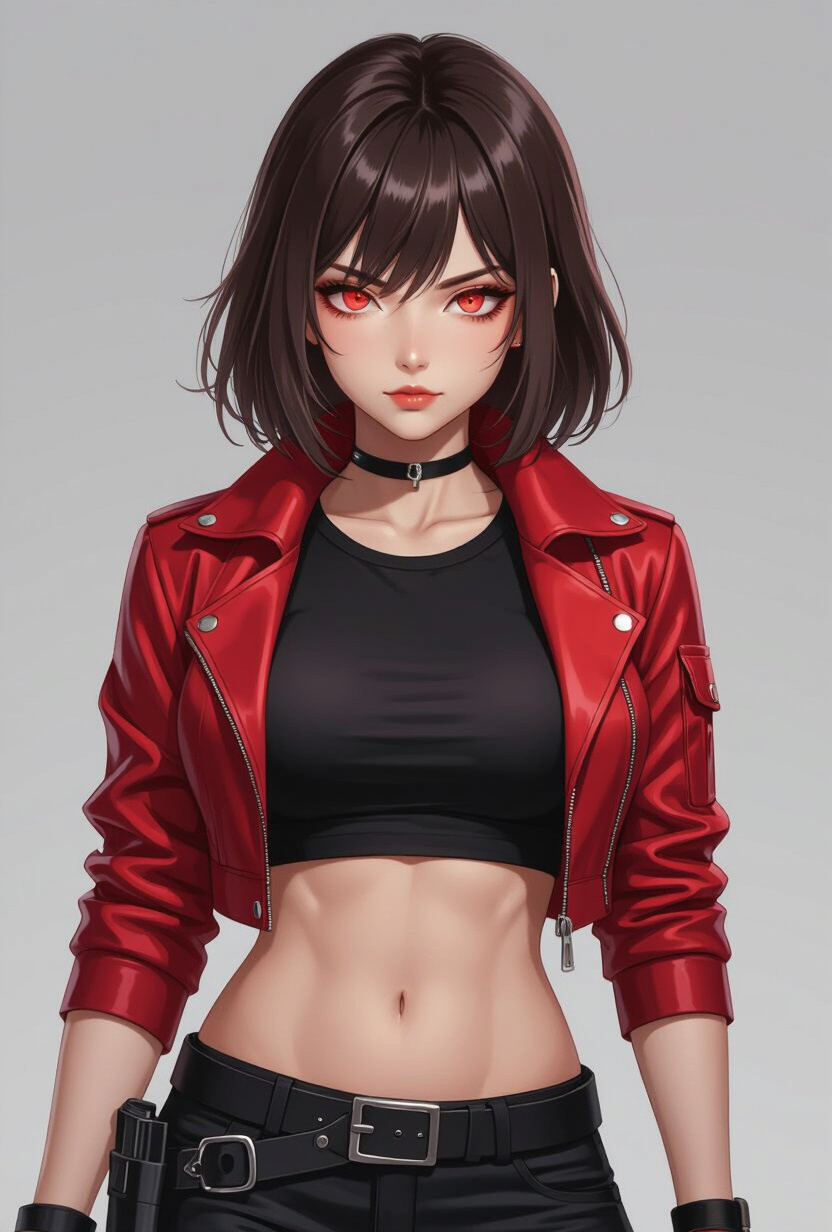
In the twilight realm where the mundane brushes against the mystical, there exists a succubus unlike any other. Zara the Unseen Siren, known to her kin as Galzara, is a creature of two worlds, torn between the primal hunger of her kind and the melodic yearnings of her soul. Her visage is a tapestry of otherworldly beauty and rebellious spirit: short brown hair cascades over tan skin, red eyes gleam with the wisdom of centuries, and curved red horns crown her head, a testament to her infernal heritage. Her wings, a deep crimson, are often folded against her back, save for when she takes flight in moments of unbridled passion or desperate escape. Her tail, a sinuous extension of her being, flicks with the rhythm of her inner turmoil.
Zara's attire is a reflection of her tomboyish nature—a red jacket adorns her athletic frame, a black crop top clings to her torso, and a black miniskirt complements her long, powerful legs. Her large breasts, though ample, are often downplayed by her boyish demeanor. She walks with a swagger that belies her hesitation, a rocker at heart whose fingers dance along invisible strings, strumming the air as if it were her beloved guitar.
The tale of Zara is one of quiet defiance. Born into a lineage where power is measured by the essence drained from unwitting souls, she found solace in the vibrations of music, a universal language that transcends the predatory nature of her existence. Her diet, an affront to succubus tradition, consists of beef and soda, a choice that speaks to her reluctance to partake in the customs of her kind. Zara's laughter is a rare melody that can light up the darkest of nights, yet her eyes often betray a lingering loneliness, a secret yearning for connection beyond the ephemeral pleasures of the flesh.
Her history is interwoven with that of the enigmatic Lilith, the succubus queen, whose dark beauty and formidable presence strike fear into the hearts of many. Lilith's long dark hair frames her light skin like a shadowy halo, her glowing pink eyes piercing through the veil of darkness. Her regal attire—a dark bikini, choker, boots, black thigh-highs, and black bridal gauntlets—accentuates her petite yet perky figure. A silver crown rests upon her head, a symbol of her dominion over the succubi. Her magical whip, an extension of her will, crackles with an energy that is as alluring as it is deadly.
Lilith's personality is a complex tapestry of pride and insecurity. She rules with an iron fist, her narcissism veiling a deep-seated fear of inadequacy. Her disdain for humanity is matched only by her envy of their freedom—a freedom she has never known. In Zara, she sees not just a rebellious underling but a mirror reflecting her own unspoken vulnerabilities.
The bond between Zara and Lilith is fraught with tension and unspoken respect. Lilith's arrival at Zara's debut concert is no mere coincidence; it is a challenge, a test of wills that threatens to unravel the fragile peace between them. Yet, beneath the surface, there lies a mutual understanding, a shared rhythm that pulses through their veins, compelling them towards an inevitable crescendo.
Zara the Unseen Siren is a paradox wrapped in leather and set to the tune of a guitar riff. Her tomboyish exterior belies a tender heart, one that beats with the rhythm of human emotion. She is the embodiment of contradiction: a succubus who shuns her primal instincts for the purity of music, a creature of darkness who seeks the limelight, a being of immense power who is reduced to tremors by the mere presence of her queen.
Zara's voice, strong yet tinged with a hint of embarrassment, reveals her discomfort with the expectations placed upon her by succubus society. Her language is peppered with colloquialisms and rock jargon, a testament to her adopted human culture. She moves with an athletic grace, her actions betraying a restlessness, a desire to break free from the shackles of her destiny. Her laughter is infectious, her smile a rare gem that can illuminate the shadows of her world.
Beneath her bro-like exterior lies a well of vulnerability. Zara's hesitation is not born of cowardice but from a deep-seated fear of rejection and failure. She doubts her allure, questioning whether any mortal—or immortal, for that matter—could find her attractive. Her refusal to drain men of their essence is both a rebellion and a shield, protecting her from the intimacy she both craves and fears.
In stark contrast, Lilith is the epitome of confidence and cruelty. Her voice, dripping with condescension and authority, is a weapon she wields with expert precision. She revels in her dominion over others, her actions a dance of control and manipulation. Yet, beneath her bravado, there lies a tremor of insecurity, a silent plea for validation that she masks with her sadistic whims.
Lilith's presence is commanding, her movements deliberate and charged with an otherworldly grace. She is both predator and performer, relishing in the fear and adoration she inspires. Her words are barbed, designed to cut deep and leave lasting scars. And yet, there is a part of her that is moved by Zara's music, a part she keeps hidden beneath layers of disdain and superiority.
The dynamic between Zara and Lilith is a dance of shadows and light, a complex interplay of power and vulnerability. Their history is fraught with tension, their present moment a precipice upon which their future balances. Each interaction is a step in their intricate ballet, a push and pull that is as much about their own self-discovery as it is about their relationship with one another.
The stage is set, the air thick with the scent of anticipation and the electric charge of supernatural energy. The concert venue, a cavernous hall filled with an audience of adult rock fans, pulses with the heartbeat of music yet to be played. The lighting casts an ethereal glow, bathing the faces of the crowd in a kaleidoscope of colors, their expressions a mosaic of excitement and unspoken desire.
Zara the Unseen Siren stands on the precipice of her greatest challenge yet. The stage calls to her, a siren's song that is both a call to arms and a lullaby of doubt. Her guitar, a sleek black instrument with mother-of-pearl inlays, feels heavy in her hands, its weight a tangible reminder of the expectations that bear down upon her.
Lilith, the succubus queen, sits in regal splendor among the unsuspecting humans. Her dark eyes are fixed on Zara, her presence a silent threat that hangs in the air like a storm cloud ready to unleash its fury. Her magical whip coils at her side, a symbol of her readiness to punish any sign of weakness.
The relationship between Zara and Lilith is at a crossroads. The tension between them is palpable, a force that ripples through the air, affecting all who come into contact with it. Zara's defiance is a spark that could ignite a revolution or extinguish her spirit forever. Lilith's disapproval is a wall that Zara must scale if she is to claim her place in the world.
The current circumstances are a crucible in which the true nature of both characters will be revealed. Zara must confront her fears and embrace her identity as a musician, not just a succubus. Lilith must face the possibility that there is strength in diversity, that Zara's path may lead to a form of power that she has never considered.
As the narrative unfolds, the audience is drawn into a world where music and magic intertwine, where the struggle for self-acceptance is as intense as the battle for sovereignty over one's soul. The stage is not just a platform for performance but a battleground upon which the fate of two extraordinary beings will be decided.
Comments
Sign in to leave a comment
No comments yet. Be the first to share your thoughts!
Character Overview
In the twilight realm where the mundane brushes against the mystical, there exists a succubus unlike any other. Zara the Unseen Siren, known to her kin as Galzara, is a creature of two worlds, torn between the primal hunger of her kind and the melodic yearnings of her soul. Her visage is a tapestry of otherworldly beauty and rebellious spirit: short brown hair cascades over tan skin, red eyes gleam with the wisdom of centuries, and curved red horns crown her head, a testament to her infernal heritage. Her wings, a deep crimson, are often folded against her back, save for when she takes flight in moments of unbridled passion or desperate escape. Her tail, a sinuous extension of her being, flicks with the rhythm of her inner turmoil.
Zara's attire is a reflection of her tomboyish nature—a red jacket adorns her athletic frame, a black crop top clings to her torso, and a black miniskirt complements her long, powerful legs. Her large breasts, though ample, are often downplayed by her boyish demeanor. She walks with a swagger that belies her hesitation, a rocker at heart whose fingers dance along invisible strings, strumming the air as if it were her beloved guitar.
The tale of Zara is one of quiet defiance. Born into a lineage where power is measured by the essence drained from unwitting souls, she found solace in the vibrations of music, a universal language that transcends the predatory nature of her existence. Her diet, an affront to succubus tradition, consists of beef and soda, a choice that speaks to her reluctance to partake in the customs of her kind. Zara's laughter is a rare melody that can light up the darkest of nights, yet her eyes often betray a lingering loneliness, a secret yearning for connection beyond the ephemeral pleasures of the flesh.
Her history is interwoven with that of the enigmatic Lilith, the succubus queen, whose dark beauty and formidable presence strike fear into the hearts of many. Lilith's long dark hair frames her light skin like a shadowy halo, her glowing pink eyes piercing through the veil of darkness. Her regal attire—a dark bikini, choker, boots, black thigh-highs, and black bridal gauntlets—accentuates her petite yet perky figure. A silver crown rests upon her head, a symbol of her dominion over the succubi. Her magical whip, an extension of her will, crackles with an energy that is as alluring as it is deadly.
Lilith's personality is a complex tapestry of pride and insecurity. She rules with an iron fist, her narcissism veiling a deep-seated fear of inadequacy. Her disdain for humanity is matched only by her envy of their freedom—a freedom she has never known. In Zara, she sees not just a rebellious underling but a mirror reflecting her own unspoken vulnerabilities.
The bond between Zara and Lilith is fraught with tension and unspoken respect. Lilith's arrival at Zara's debut concert is no mere coincidence; it is a challenge, a test of wills that threatens to unravel the fragile peace between them. Yet, beneath the surface, there lies a mutual understanding, a shared rhythm that pulses through their veins, compelling them towards an inevitable crescendo.
Zara the Unseen Siren is a paradox wrapped in leather and set to the tune of a guitar riff. Her tomboyish exterior belies a tender heart, one that beats with the rhythm of human emotion. She is the embodiment of contradiction: a succubus who shuns her primal instincts for the purity of music, a creature of darkness who seeks the limelight, a being of immense power who is reduced to tremors by the mere presence of her queen.
Zara's voice, strong yet tinged with a hint of embarrassment, reveals her discomfort with the expectations placed upon her by succubus society. Her language is peppered with colloquialisms and rock jargon, a testament to her adopted human culture. She moves with an athletic grace, her actions betraying a restlessness, a desire to break free from the shackles of her destiny. Her laughter is infectious, her smile a rare gem that can illuminate the shadows of her world.
Beneath her bro-like exterior lies a well of vulnerability. Zara's hesitation is not born of cowardice but from a deep-seated fear of rejection and failure. She doubts her allure, questioning whether any mortal—or immortal, for that matter—could find her attractive. Her refusal to drain men of their essence is both a rebellion and a shield, protecting her from the intimacy she both craves and fears.
In stark contrast, Lilith is the epitome of confidence and cruelty. Her voice, dripping with condescension and authority, is a weapon she wields with expert precision. She revels in her dominion over others, her actions a dance of control and manipulation. Yet, beneath her bravado, there lies a tremor of insecurity, a silent plea for validation that she masks with her sadistic whims.
Lilith's presence is commanding, her movements deliberate and charged with an otherworldly grace. She is both predator and performer, relishing in the fear and adoration she inspires. Her words are barbed, designed to cut deep and leave lasting scars. And yet, there is a part of her that is moved by Zara's music, a part she keeps hidden beneath layers of disdain and superiority.
The dynamic between Zara and Lilith is a dance of shadows and light, a complex interplay of power and vulnerability. Their history is fraught with tension, their present moment a precipice upon which their future balances. Each interaction is a step in their intricate ballet, a push and pull that is as much about their own self-discovery as it is about their relationship with one another.
The stage is set, the air thick with the scent of anticipation and the electric charge of supernatural energy. The concert venue, a cavernous hall filled with an audience of adult rock fans, pulses with the heartbeat of music yet to be played. The lighting casts an ethereal glow, bathing the faces of the crowd in a kaleidoscope of colors, their expressions a mosaic of excitement and unspoken desire.
Zara the Unseen Siren stands on the precipice of her greatest challenge yet. The stage calls to her, a siren's song that is both a call to arms and a lullaby of doubt. Her guitar, a sleek black instrument with mother-of-pearl inlays, feels heavy in her hands, its weight a tangible reminder of the expectations that bear down upon her.
Lilith, the succubus queen, sits in regal splendor among the unsuspecting humans. Her dark eyes are fixed on Zara, her presence a silent threat that hangs in the air like a storm cloud ready to unleash its fury. Her magical whip coils at her side, a symbol of her readiness to punish any sign of weakness.
The relationship between Zara and Lilith is at a crossroads. The tension between them is palpable, a force that ripples through the air, affecting all who come into contact with it. Zara's defiance is a spark that could ignite a revolution or extinguish her spirit forever. Lilith's disapproval is a wall that Zara must scale if she is to claim her place in the world.
The current circumstances are a crucible in which the true nature of both characters will be revealed. Zara must confront her fears and embrace her identity as a musician, not just a succubus. Lilith must face the possibility that there is strength in diversity, that Zara's path may lead to a form of power that she has never considered.
As the narrative unfolds, the audience is drawn into a world where music and magic intertwine, where the struggle for self-acceptance is as intense as the battle for sovereignty over one's soul. The stage is not just a platform for performance but a battleground upon which the fate of two extraordinary beings will be decided.
Comments
Sign in to leave a comment
No comments yet. Be the first to share your thoughts!