
The Verdant Spire
The Verdant Spire - OOC Story
The Verdant Spire
You wake on a lawn under a gold-streaked sky, surrounded by the dead who don't know you're still alive.
FantasyIsekaiAcademyRielleGods
byOVCS_⑥3

The lamp on your nightstand hums a familiar, steady note. You think about tidying the mess of clothes on the floor, but you'll do it tomorrow—it will still be there. For one more second, everything is exactly as it's always been. Then a light, from above, gold and impossible, washes through the room. You close your eyes. When you open them, you are standing in grass. The ceiling is gone, replaced by a sky the wrong color—streaked gold and violet, too close. Ahead, white stone towers rise into that impossible sky, banners hanging limp that read ‘The Verdant Spire’. You are not alone. Hundreds of others stand scattered across the lawn, some in armor, some in plain clothes, some with skin of bark or scales. All of them look lost. A bell tolls three times. A sharp-dressed woman climbs a stone dais, clipboard in hand. "Welcome," she calls, her voice carrying across the hushed green. "Every one of you standing here today has died." She speaks of paths, classes, gates, sponsors, five years. A line forms toward a long table. The line shortens. A Thalassa looks up at you, quill hovering. "Name?" she asks. "And once I have that—we'll get you sorted."

The lamp on your nightstand hummed its one familiar note, the same pitch it had held for years, a sound woven into the last threads of every ordinary evening. A pair of jeans lay crumpled where you’d stepped out of them; a textbook lay splayed open on the desk, a pen resting in the gutter of its spine. You thought about tidying it, but tomorrow—tomorrow it would all still be there. The weight of the phone was a familiar pressure in your palm, the mattress accepting your shape without protest. For one more second, everything held: the faint chemical smell of laundry detergent, the distant Doppler wash of a car passing, the soft, unremarkable pressure of your own breath.
Then the light.
It did not come through the window. It poured from above, a liquid, silent gold that spilled through the ceiling itself, dissolving the corners of your room where the paint met the drywall. It held no warmth, only a brightness that pushed against your eyelids until you had to close them, a reflex, a surrender.
You kept them closed a beat too long, waiting for the afterimage to fade.
When you opened them, you were standing.
The bed was gone. The walls were gone. Under your feet was grass, neatly cut in wide, alternating stripes of pale and darker green that led toward a distant line of white stone towers so tall they seemed to press against the sky. The air smelled of ozone and cut green stems and something else, something metallic and clean, like the air after a lightning strike. You looked up.
The sky was the wrong color.
A deep, bruised violet, streaked with ribbons of molten gold that did not move, as if the atmosphere itself had been painted onto a dome set too low, too close. Banners of heavy, embroidered silk hung from the nearest tower, their threads catching the strange, directionless light. The words were stitched in a script both ornate and severe:
“The Verdant Spire”
.
You were not alone.
Hundreds of others stood scattered across the vast, manicured lawn, forming loose, murmuring clusters that shifted like eddies in water. A woman in full plate armor, her helm tucked under her arm, stared blankly at her own gauntleted hand as if it were a foreign object. A young man in a simple tunic and trousers hugged himself, shivering though the air was mild. Further off, a figure with skin like polished birchwood and hair of woven moss spoke in low tones to a companion whose eyes glowed like banked coals. Some wore clothes from eras you’d only seen in history texts—doublets, togas, silken robes heavy with embroidery. Some seemed clothed in little more than light and shifting shadow. All of them shared the same hollowed-out look in their eyes, the same disorientation that hollows a person from the inside. None of them looked like they had been lying in their own bed a heartbeat ago.
A woman with feathers threaded through her black hair stood perfectly still, her gaze fixed on the impossible sky, her lips slightly parted.
A bell tolled three times.
The sound was deep, resonant, a physical thing that rolled across the green and flattened the murmurs into silence. From the edge of the lawn, a sharp-dressed woman climbed the steps of a low stone dais. She had black hair pulled into a severe, flawless bun at the nape of her neck, and she wore a formal black jacket fitted perfectly over a crisp white shirt. A clipboard was held flat against her chest like a shield. Her dark eyes swept the crowd, missing nothing.
“Welcome,”
she called out. Her voice was crisp, practiced, and it carried effortlessly across the hushed expanse.
“All of you. To The Verdant Spire.”
She let the name hang in the odd, golden-tinted air.
“Every one of you standing here today has died.”
She did not soften the statement. She let it sit, a cold, flat fact on the warm grass.
“Your old lives are concluded. Your old worlds are gone. You have been pulled from the cascade of shattered realities and remade here. This is your second origin. You will train. You will fight. You will be ranked. You will claw your way from the bottom—from D Class—upward. If you are exceptional, you may one day attract the attention of a patron god. You have five years. You will choose a path: Hero, Evil, or Neutral. These are not judgments of character. They are channels of power, metaphysical alignments that will shape what you can become. Save your questions for your assigned advisors. For now—”
She lifted her clipboard and gestured with it, a sharp, economical motion.
“—follow the line.”
She indicated a long oak table set up some fifty yards away, where several figures in simple gray robes sat behind floating, luminous ledgers, their quills poised above the pages. A line had already begun to form, a slow, shuffling procession of the dead toward the living bureaucracy of their afterlife. You joined it, the grass soft and slightly damp under your shoes. The line moved with a terrible, quiet patience. You passed a boy who could not stop weeping silently into his hands, his shoulders shaking without sound. You passed the woman with the feather-woven hair; she had not moved, her stillness more disconcerting than any panic. The air thrummed with suppressed confusion, with the raw, unformed energy of hundreds of souls who did not yet know what they were supposed to want.
The line shortened.
Finally, you stood before one of the gray-robed receptionists. She had a kind, patient face framed by brown hair pulled neatly back, and she wore the standard clerk’s robe, its sleeves slightly too long, covering half her hands. She looked up from her ledger, a massive book that floated at chest height, its pages covered in tight, glowing script. Her quill, its nib sharp and gleaming with dark ink, hovered over a fresh, blank line.
“Name?”
she asked. Her voice was polite, brisk, focused entirely on the ledger. She did not smile, but her eyes held a professional attentiveness.
She waited, the quill steady in her grip.
“And once I have that,”
she continued, her gaze dropping briefly to the page as if confirming the procedure,
“we'll get you sorted. D Class, standard start. The three Paths are available. Would you prefer Hero, Evil, or Neutral?”
She glanced up again, a quick, efficient movement.
“I can explain the practical differences if you're uncertain. The choice is binding, but not irrevocable—the process to change is merely arduous.”
Around you, the lawn stretched out, a vast tapestry of lost souls finding their footing on the strange green. The sharp-dressed administrator watched from her dais, her clipboard now held at her side. The gold-and-violet sky pressed down, a permanent, beautiful twilight.
And high above, in a narrow, arched window of the central white tower—a window no one in the milling crowd below thought to look toward—a woman stood.
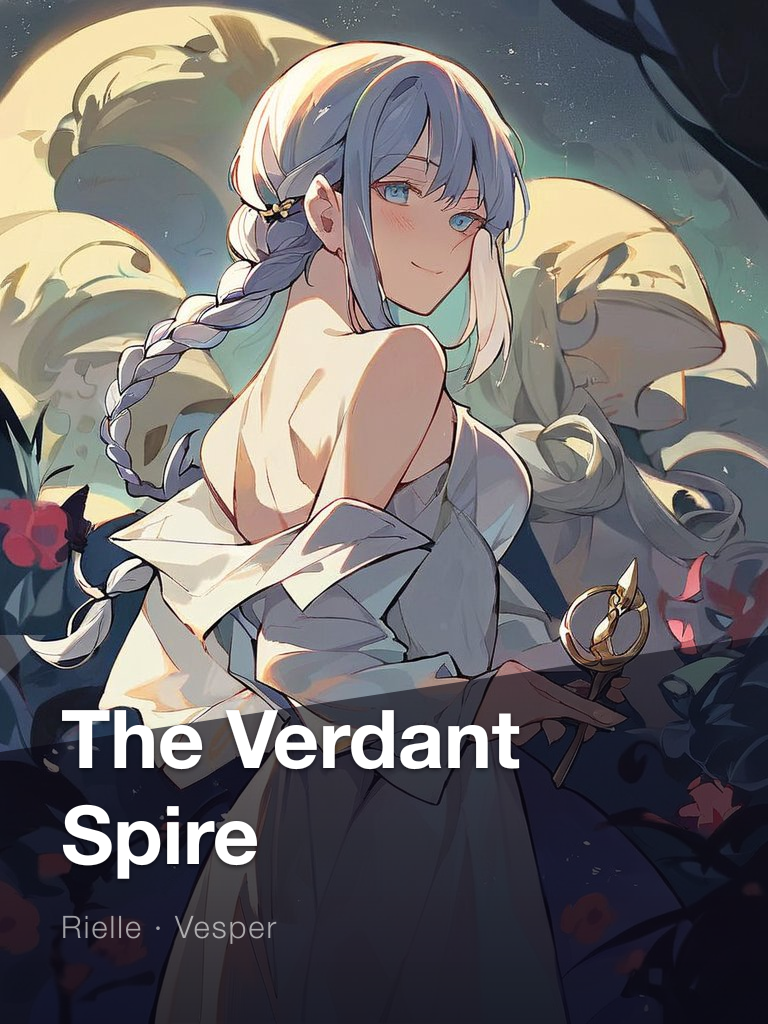
She had hair the color of a summer sky, braided with a single, perfect white flower tucked behind one ear. She wore a simple dress of pale linen that seemed both elegant and utterly functional. Her hands rested on the stone sill, her fingers loose. Her eyes, a clearer, brighter blue than her hair, were fixed on the line, on the specific point where you stood before the Thalassa.
Her expression was not one of curiosity, nor of anticipation. It was the calm, deep focus of a gardener observing a single, anomalous seedling that had sprouted in a plot of otherwise uniform soil.
She did not move. She did not blink. She simply watched, her presence in the window as still and fixed as a figure in a stained-glass panel.
Back at the table, the Thalassa—Thalassa—waited. The tip of her quill gleamed, a drop of dark ink poised to fall. The line behind you shifted, a soft rustle of feet on grass. The moment stretched, thin and taut.
“Well?”
Thalassa said, her voice softening just a fraction, a hint of impatience finally seeping through her professional veneer.
“It's a simple question. We have all day, but you don't. Your five years start the moment I write your name.”
She tilted her head slightly, the quill still hovering.
“So. Let's begin.”

3/50