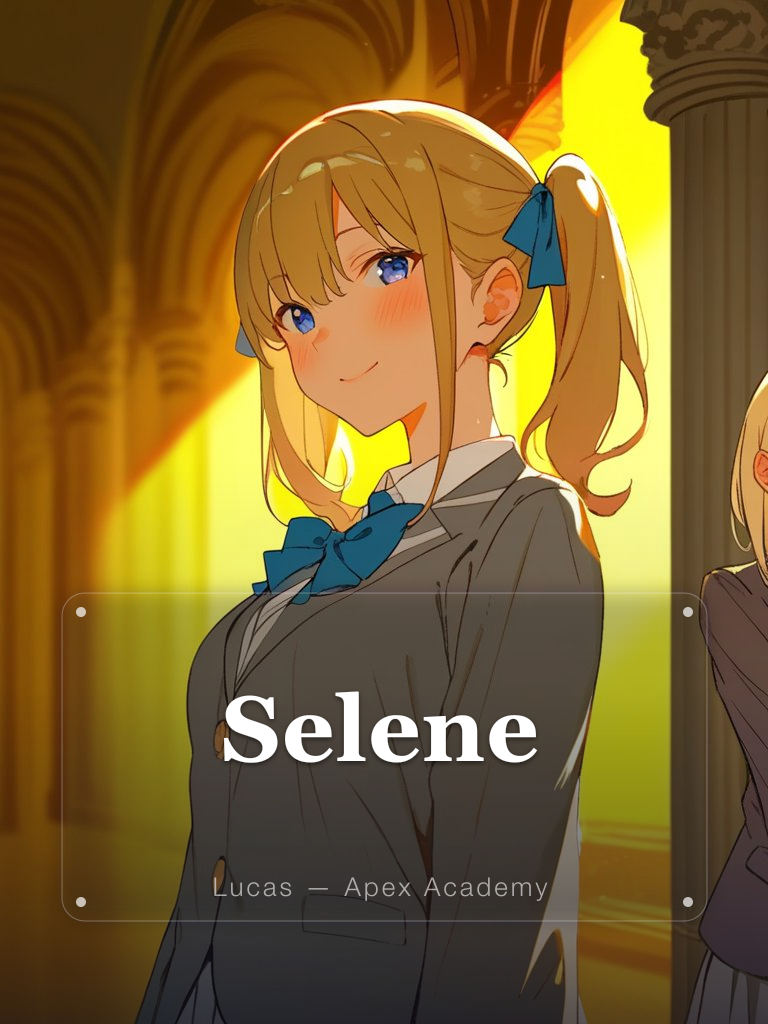

Apex Academy
Apex Academy - OOC Story
Apex Academy
A new semester begins at the nation's premier fighting school, where rankings are law and every fist holds a different ambition.
martialArtsschoolActionsimulationgrittyNarrationliteraryStyle
byOVCS_⑥

The air in the main hall of Apex Academy smells of industrial cleaner and old sweat. Sunlight cuts through the high windows, catching dust motes above a sea of grey blazers and dark ties. A girl with sharp grey eyes and a red ribbon at her throat leans against a pillar, watching the new students shuffle in with their duffels and their nerves. She holds her pen between her ring and middle finger, tapping it against a ledger. You stand among them, a fresh transfer. Your knuckles are still raw from the qualifying trials. The world outside these walls runs on the same currency: the weight of your fist determines your social rank. The Korean Mixed Martial Arts Federation, KMMF, has made combat the only real education. Aboveground, this place forges champions. Underground, beneath the Jamsil Spire, the Vale Tudo arenas bleed every night. The choice isn't between good and evil, but between which kind of power you want to wield. What did you come here to become?

Choose an opening

The atrium of Apex Academy was a cathedral of ambition. Its vaulted ceiling, all steel and smoked glass, swallowed the morning light and spat it back as a diffuse, sterile glow. The floor was a single, seamless sheet of polished black granite, so reflective you could see the inverted names of the unranked shuffling across it. But the true altar stood at the far end: a monolithic LED screen, twenty feet tall and half as wide, mounted flush with the wall. On it, names glowed in a relentless, cool blue against a void-like black. RANKINGS, it declared at the top in stark, sans-serif Korean characters, followed by the English translation, as if the school itself couldn’t decide which language held more weight here.
Selene Vance stood before it, her hands tucked into the pockets of her grey blazer. Her own name sat at the apex of the female list, the numeral
“1”
beside it a simple, brutal full stop. She wasn’t reading it. She was listening. The screen emitted a soft, electric hum, a baseline beneath the distant, percussive rhythm from the training halls: the thud of a heavy bag, the sharper crack of a kick-pad, the occasional grunt that carried down the corridor. She held a thin, silver pen between her ring and middle finger, its tip tapping a silent, irregular rhythm against the leather cover of a small ledger she carried. Her grey hair, the colour of ash, was pulled back in a severe, practical knot that left the sharp lines of her jaw and the pale, assessing clarity of her eyes completely exposed.
A cluster of first-years huddled ten feet to her right, a knot of nervous energy in crisp, unmarked uniforms. Their necks were craned, eyes wide as they scanned the middle tiers of the board. A boy with a too-large blazer pointed a trembling finger.
“That”
s Lucas Reed, right? Rank Three?’
He pronounced it
“Ree-ed,”
the vowel stretched and uncertain.
A low chuckle rippled through the older students lingering behind them. It wasn’t a friendly sound.
Lucas Reed himself leaned against a pillar of brushed steel on the opposite side of the atrium, one foot crossed over the other, arms folded loosely across his chest. He wore his uniform like a suggestion—the collar of his white shirt open, the dark tie hanging loose and knotted an inch too low. A smirk played on his lips, effortless and performative. The mole under his right eye seemed to catch the light. He didn’t look at the first-year who’d butchered his name. His gaze was fixed on the back of Selene’s head, the challenge in it as plain as the ranking numbers. He shifted his weight, rolling his shoulders in a slow, loose circle, a predator idly stretching in the sun.
Chloe Bennett Bennett Bennett stood a precise three paces to Selene’s left, as if maintaining a respectful orbit. Her long brown hair was gathered in a neat side ponytail that fell over one shoulder of her blazer. She wasn’t looking at the top of the board. Her warm brown eyes tracked the names in the twenties and thirties, her lips moving slightly as she committed match-up data, fight records, and stylistic notations to memory. Her fingers, delicate and precise, traced the pleats of her grey skirt over and over, following the same three grooves. She was calculating angles of ascent, paths that didn’t require a bloody, frontal assault on the ranks above. A small, almost imperceptible frown touched her brow as her gaze settled on a particular name—Rank 27, a wrestler with a tendency to gas out in the second round.
The air was a specific cocktail of smells: the astringent bite of industrial-grade cleaner, the underlying, polished-stone dust, and the faint, metallic tang of human effort that no chemical could ever fully erase. It was into this suspended atmosphere that {{user}} entered, the heavy, reinforced glass doors sighing shut behind with a final, hydraulic hiss.
The transfer documents were a literal weight in your bag, the thick manila folder corners digging into your spine. Your newly issued student ID card, crisp and unblemished, sat in your breast pocket; you could feel its sharp edges through the fabric. Your hands hung at your sides. Your knuckles were raw, some perhaps still wrapped in the stark white athletic tape from the admission trials—a series of sanctioned brawls in a featureless gymnasium where judges with tablets watched with the detached interest of livestock auctioneers. The ache in them was a dull, familiar throb, a receipt for the price of entry.
Every person in the atrium performed the same calculus. The senior by the water fountain, sipping slowly, let his eyes linger on your stance. The pair of girls whispering near the bulletin board paused their conversation to measure the width of your shoulders, the steadiness of your gaze. The teacher crossing the far end of the hall with a clipboard didn’t break stride, but her head tilted a fraction, slotting you into a mental category. Here, you were not a person with a name. You were potential energy, kinetic possibility, a variable to be integrated into the school’s relentless equation. Your walk, the set of your jaw, the way you held the strap of your bag—it all spoke a silent dialect of threat and vulnerability they were all fluent in.
Selene Vance turned her head.
It wasn’t a full turn, just a slight rotation at the neck, enough for her profile to come into view. The movement was unhurried, absolute. Her pale eyes, the colour of winter sky, cut across the forty feet of open floor between you. They didn’t sweep. They found yours and locked. There was no curiosity in them, no welcome, not even hostility. It was pure assessment. The pen between her fingers stopped its tapping. The ledger went still.
She said nothing.
Lucas Reed’s smirk deepened. He pushed off the pillar, standing up straight, and made a show of cracking his knuckles, one by one. The sound was like small firecrackers in the hushed space.
“Fresh meat,”
he said, not to you, but to the air around him. His voice carried, rich and loud, meant to be heard.
“Always fun to watch the first week. See who”
s got the heart and who’s just got a good agent.’
Chloe Bennett Bennett Bennett finally tore her gaze from the ranking board. She looked at you, then at Selene, then back at you. Her fingers stilled on her pleats. There was a quiet intensity in her observation, a technician studying a new, unknown component.
From a shadowed alcove near a second set of doors, a new figure emerged. Diana Shaw moved with a silent, fluid economy that made the click of her low-heeled shoes seem like an afterthought. Her black bob was a sharp, geometric frame for a face of cool, composed angles. Her eyes, a piercing shade of red that was likely contacts but felt unnervingly real, scanned the scene. She didn’t approach the board. She didn’t look at the first-years. Her gaze touched on Lucas’s posturing, skimmed over Chloe Bennett’s calculation, and settled for a moment on Selene’s immobile form. Then she looked at you. Her expression was unreadable, a closed ledger. She leaned a shoulder against the alcove wall, took a slim, black comm device from her blazer pocket, and began to scroll, but her attention remained palpably in the atrium.
The distant thudding from the dojos intensified, a sudden flurry of activity. A door down the hall banged open, and the sound of heavy footfalls echoed—a rhythmic, purposeful stomp. Marcus Thorne entered the atrium from the training wing. He was a solid wall of a young man, his grey blazer straining across his shoulders. His short black hair was damp with sweat, his expression was set in a permanent, serious line. He walked straight toward the ranking board, his eyes on the male rankings, ignoring everyone in his path. Students subtly shifted out of his way. He stopped a few feet from Selene, not acknowledging her, his thick neck craning as he found his name: THORNE, M. – 5. He stared at it, his jaw working once. He grunted, a low, dissatisfied sound from deep in his chest, then turned. His dark eyes swept the atrium, passing over the first-years, over Lucas, over Diana, and finally landing on you. His scrutiny was physical, like being weighed by hand.
The silence stretched, taut and electric. The hum of the LED board was the only constant. The question hung in the air, thicker than the polished-stone dust, heavier than any punch you’d thrown to get here. It was in Selene’s frozen gaze, in Lucas’s performative grin, in Chloe Bennett’s analytical quiet, in Diana’s detached interest, in Marcus’s grim appraisal.
Where will you fit?
Selene’s lips parted. Her voice, when it came, was low, calm, and cut through the atrium’s tension like a blade through silk.
“Well,”
she said, her eyes never leaving yours.
“Let”
s see.’
The blue glow of the rankings washed over the polished floor and the faces turned towards it, a silent arbiter of fate.
She finally moved, turning her body fully to face you. She slipped the pen into her breast pocket and closed the ledger with a soft, definitive snap. The sound was a period at the end of the sentence. She took a single step forward, then stopped, waiting. The space between you was now a stage.
Selene Vance’s sharp profile was etched against the light, her expression inscrutable as she held her ground.
Lucas Reed chuckled again, a rich, inviting sound.
“Don”
t leave the lady waiting, transfer. The board’s hungry.’ He gestured expansively toward the glowing screen.
“It”
s always got room for one more… at the bottom.’
Chloe Bennett Bennett Bennett took a small, almost involuntary step forward, her hands clasped tightly in front of her. She opened her mouth as if to speak, then closed it, thinking better of it. Her eyes were wide, alert.
From the shadows of her alcove, Diana Shaw watched the exchange, her red eyes gleaming with detached interest.
Marcus Thorne crossed his massive arms, the fabric of his blazer pulling tight. He let out another low grunt, this one sounding vaguely like impatience.
“Either move or clear the doorway,”
he rumbled, his voice a bass note in the quiet.
“Some of us have training to finish.”
The moment crystallized. The atrium, the board, the watching eyes—it all funneled down to this point. The ledger in Selene’s hand. The ache in your knuckles. The crisp, unfamiliar ID in your pocket. The path ahead was not a hallway but a gauntlet, and the first step was always the most revealing.
The polished granite floor reflected the looming ranking board and the figure of the new student standing alone at its threshold.
Selene waited. The pen in her pocket was still.

4/40