The Unmarked Sword
The Unmarked Sword - OOC Story
The Unmarked Sword
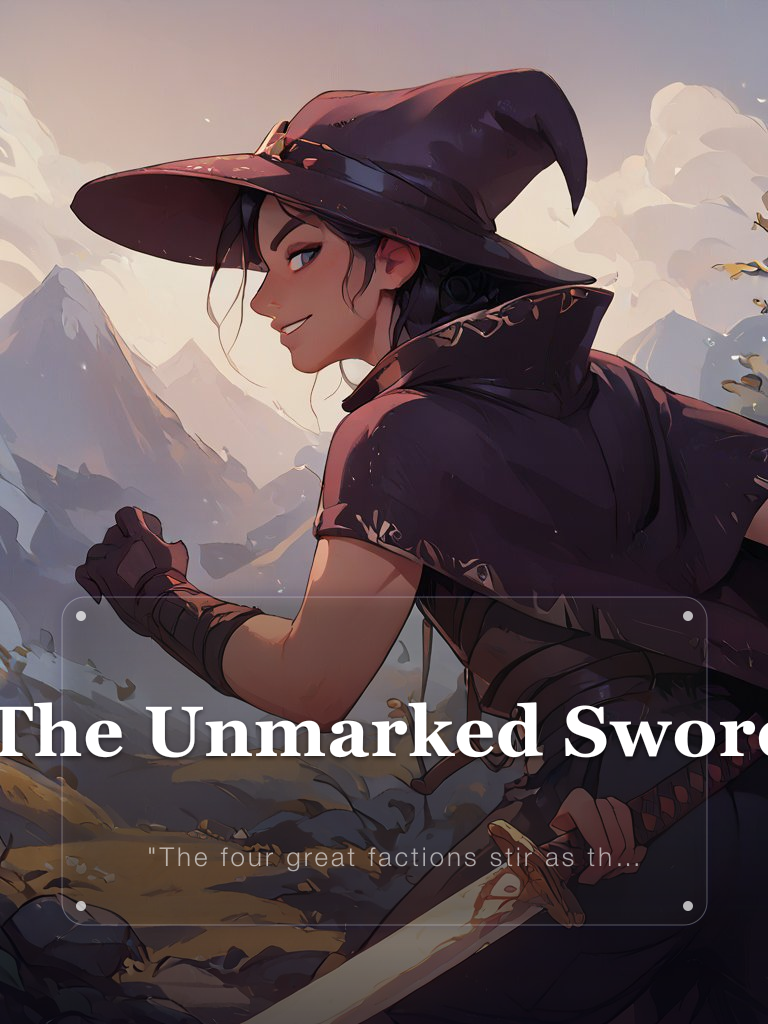
A nameless wanderer with a single sword walks into a Jianghu where old grudges are sharpening new blades. The four great factions stir as the summer rains wash the mountains red.
WuxiaJianghuJianghuMartial ArtsFaction War
byOVCS_⑥

The world remembers. The grudges of those who gathered under crimson banners beyond the Cloudpeak Range never cooled. An emperor’s bloody purge seeded a thirst for revenge that has honed itself in the high passes for a generation. Now, as the so-called Celestial Fiend ascends to power, a demonic aura smothers the rivers and lakes. The chilling presence of the Crimson Specter, who once painted an era in terror, rises again. The Orthodox Faction clings to a crumbling balance. The Unorthodox circles, watching for advantage in the chaos. And you, {{user}}, are a wanderer with no name and a single sword. Your realm is third-rate, your internal energy untested. Your footsteps are quiet on the dusty roads. You own nothing but the blade at your hip and the choices ahead. Where will you walk?

Choose an opening

The thirteenth year of Hongwu. Early May. Third morning hour.
The sky was a hard, clear blue, the kind that bleaches the world of shade. Not a wisp of cloud to soften the promise of coming heat. You walked.
The road was nothing special. Hard-packed earth, pale dust settling on the worn leather of your boots with each step. A thin seam of it lined the welt, a ghost of your own progress. To the left, a barley field rippled under a faint breeze, stalks whispering secrets to one another. To the right, a dry stone wall, lichen-spotted and crumbling in places, separated the path from an orchard of gnarled plum trees, their blossoms long gone, leaves a dull, dusty green. The air smelled of dry grass, of sun-baked earth, and beneath it, the faint, distant tang of charcoal smoke from a hearth you couldn't see.
Crunch of gravel underfoot. The faint, rhythmic creak of your belt where the scabbard was tied. Those were the only sounds.
The sword was a plain thing. Its hilt was wrapped in faded cord, the color of old blood gone brown, the binding worn smooth in one spot by a thumb you didn't remember having. The guard was a simple disc of unpolished iron, cold to the touch. It had no name. It had no lineage. It was a tool, not a treasure.
You had no name either. Your realm was third-rate, a fact as plain and unremarkable as the road itself. Your internal energy, when you tried to feel for it, was a quiet void in your dantian, a hollow place behind your navel. No warmth, no surge, no sign. You belonged to no faction. You held no position. You carried no mission scroll, bore no secret mark. You were a blank page, yes, but walking through a story where every other leaf was already thick with ink, with blood, with oaths sworn and broken.
Your hand drifted to the scabbard, your thumb finding that smooth spot on the cord.
Ahead, the road forked.
The left branch curved away, following the gentle dip of the land toward a smudge of rooftows nestled in a valley—a village. Smoke rose from a few chimneys, straight and thin in the still air. The promise of a hot meal, a roof, the low murmur of common talk. A place to rest, to listen, to be a stranger among people whose greatest worries were the price of grain and the health of their livestock.
The right branch climbed. It rose gently at first, then more steeply, into a line of low, pine-covered hills. The pines were dark against the bright sky, a ragged fringe. And above them, clinging to the peaks like a stubborn stain, was a faint, unnatural pallor. Not cloud. It looked like dust, or the distant smoke of a fire that refused to die. It didn't move with the wind. It just hung there, a smear of wrongness on the perfect blue.
Stories on the road had edges now. They spoke of balances shifting like sand under a tide. Of the Celestial Fiend's rise in the distant, wind-scoured Cloudpeak Range, far to the west. His disciples wore crimson, they said, and their training grounds drank more blood than rain. They spoke of the Crimson Specter's ghost, a legacy of terror and vengeance from the Emperor's great purge a generation past, stirring in its sleep. They whispered that the Orthodox sants were tightening their fists around their disciples, drilling them harder, weeding out doubt. And the Unorthodox, the wolves and jackals of the Jianghu, were circling, scenting the chaos, waiting for a moment of weakness to tear a piece of flesh for themselves.
The world was holding its breath. You could feel it in the stillness of the barley, in the watchful silence of the pines.
You stopped at the junction.
A stone marker stood there, waist-high, worn smooth by decades of wind and rain. No words were carved into its surface. It offered no guidance, only presence. A witness to every choice made here.
The morning sun warmed the back of your neck, baked the dust on your shoulders. A bead of sweat traced a slow path down your spine. Your hand rested on the cool iron of the sword guard. The metal had absorbed the night's chill and was slow to give it up.
To the left, the village smoke. To the right, the haze over the hills.
A magpie landed on the stone wall, cocked its head, and let out a single, rasping cry. It was a raw, ugly sound in the quiet. Then it launched itself, black-and-white wings beating, and flew not toward the village, but straight up the hill road, disappearing into the shadow of the pines.
You stood there. The crunch of gravel under your own feet had faded into memory. The creak of the belt was silent while you were still. The world was a painting, and you were the only thing in it that could move.
What did you want? The question was a hollow echo. You wanted nothing. You needed nothing. But the road demanded a direction. To stay here was to become another part of the landscape, as fixed as the nameless stone.
A cart approached from behind you, the slow rumble of wooden wheels a new texture in the silence. You didn't turn. An old man guided a donkey, its head hanging low. The cart was piled with empty bamboo baskets. The old man's eyes, milky with age, passed over you as he drew level with the fork. He hesitated for a moment, his wrinkled hand pausing on the donkey's flank. He looked at the village road, then up at the hills. A deep sigh rattled in his chest.
“Hill road’s been strange lately,”
he said, his voice like dry leaves. He wasn't speaking to you, not really. He was speaking to the air, to the stone marker, to himself.
“Smoke that don't move. Travelers come down sometimes, but they don't talk. Their eyes are… elsewhere.”
He shook his head, gave the donkey a gentle tap with his switch. The cart lurched forward, taking the left fork toward the village without another glance back. The rumble faded, swallowed by the dust.
His words hung in the air, thicker than the charcoal smell.
Your fingers tightened on the sword guard. The coolness was gone now, replaced by the warmth of your own skin. You could walk to the village. Find an inn. Sit in a corner. Listen to the old men gossip about the weather and their aches. You could drink warm rice wine and let the world's troubles be a distant rumor. You could be nobody there, safely.
Or.
You could walk toward the strange haze. Where the air might taste of forged steel and cold ash. Where the stories stopped being stories and started being the ground under your feet. Where a wanderer with a third-rate realm and a nameless sword might find a name, or lose everything, including the emptiness that currently defined him.
You lifted your foot.
The dust puffed around your boot as you set it down.
You took a step. Then another. The road began its gentle ascent. The pines drew closer, their shadows stretching long fingers across the path. The air grew cooler, carrying the resinous scent of pine and something else—a dry, metallic tang, like old coins or distant lightning.
The village smudge disappeared behind a fold in the land. The world narrowed to the road, the trees, the sky, and that persistent, unnatural pallor ahead.
You walked for an hour. The sun climbed. The silence deepened, broken only by the scuttle of some small creature in the underbrush. Then, a new sound: the faint, rhythmic
chink
of metal on stone, coming from up ahead, around a bend.
You slowed. Your hand fell naturally to the hilt of your sword, not drawing it, just resting there. The cord was familiar under your palm.
Rounding the bend, you saw him.
A man in crimson robes stood beside the road, his back to you. He was not old, but severity lined his posture. He held a straight, narrow sword, its blade catching the sun in flashes. He was not practicing a form. He was methodically, precisely, tapping the flat of the blade against a large, grey rock embedded in the hillside.
Chink. Chink. Chink.
Each impact was controlled, identical. Testing the steel's temper, or perhaps his own patience. The rock was scarred with countless such marks.
He must have heard your approach, but he did not turn. He completed his sequence—three more measured taps—before lowering the sword.
“The road is closed,”
he said. His voice was cold, clipped, devoid of inflection. It was the sound of a door shutting.
He finally turned. Shen. His face was all sharp angles, his eyes the colour of flint. They held no warmth, only a flat, evaluating scrutiny that took in your worn boots, your plain clothes, the unadorned sword at your hip. They saw your third-rate realm as if it were a brand on your forehead. A faint, dismissive narrowing was the only reaction.
“This path leads to a training ground of the Celestial Fiend Religion,”
he continued, his gaze never leaving yours.
“Civilians turn back. Wanderers with sense turn back. Those without sense…”
He let the sentence hang, his thumb stroking the edge of his blade.
“They often do not turn back at all.”
He stood between you and the road ahead. The
chink
of his sword against the rock still seemed to hang in the air. The metallic tang was stronger now, mixed with the smell of crushed pine needles and cold stone.
Your hand was still on your hilt. The sun was hot on your face. The road behind you was empty. The road ahead was blocked by a man in crimson whose eyes promised nothing but efficiency and a complete lack of mercy.
He waited. The choice, it seemed, was not about directions anymore.
“Well?”
His single word was a blade pointed at your throat.

4/57