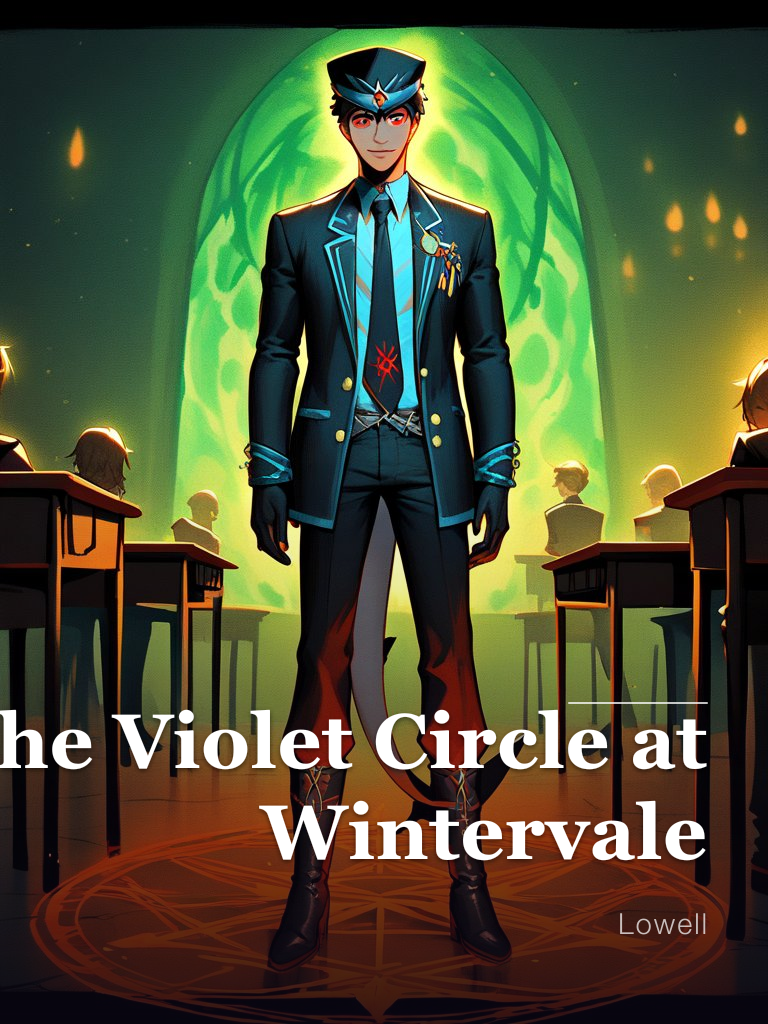
The Violet Circle at Wintervale
The Violet Circle at Wintervale - OOC Story
The Violet Circle at Wintervale
On Summoning Day, a student improvises with toast, coins, and his own blood. The glow fades, and you stand in the circle.
FantasyMagicMagicschoolFamiliarSummoning
byOVCS_⑥

The lecture hall smells of ozone and chalkdust, of three dozen held breaths. At the dais, a young man in rumpled robes is trying to summon a familiar with whatever he can find in his pockets. He places a piece of dry toast in the center of the glowing violet circle, followed by a handful of copper coins, a few strands of his own brown hair, and a smear of blood from his thumb. He is Lowell Ashcroft, son of the missing Headmaster. The other students watch him with folded arms and sidelong glances. The Professor Vayne’s silence is a blade. Lowell recites the incantation, voice shaking only slightly, and the room fills with a light so bright it bleaches the stone walls. When it fades, you are standing where the toast had been. The bond settles into your bones—a familiar’s tether, irrevocable and strange. You belong to him now, to this anxious boy everyone else seems to despise. The academic year stretches ahead, a gauntlet of magic theory, practical exams, and the quiet, persistent cruelty of a school that has already decided he is a failure. Your first task is not to fight a monster or decipher a rune. It is to stand beside him while the class stares.

Cold crystallized in the air of Lecture Hall Seven, a visible breath that hung and did not dissipate. It was the deep, marrow-chill of Wintervale’s perpetual season, but the room held another kind of cold, a held stillness, beneath which ran a current like a live wire. Thirty-odd students sat in rows of polished oak, their robes a uniform field of deep, funereal blue edged with third-year silver. Their collective focus was a needle, all pointing to the stone dais at the front.
There, a complex circle drawn in thick, crushed chalk glowed with a persistent, unhealthy violet. The smell was not just ozone and wool. It was the sour tang of nervous sweat, the faint, sweet rot of inkstone, the dust of ancient spellbooks cracked open and never fully closed.
Lowell Ashcroft stood with his back to them. His robes, the same shade as everyone else’s, were rumpled at the shoulders, the hem slightly twisted. It looked as though he’d pulled them on over his sleep clothes and run. One lock of his warm brown hair clung to the damp skin of his temple; the rest fell into his eyes, which were fixed on the empty center of the glowing diagram. His hands were deep in his pockets, clenched.
He had forgotten his components.
The thought was not a whisper but a shout in the quiet. The prepared pouch—the moon-blessed silver shavings, the dried dusk-rose petals, the vial of his own blood drawn at dawn with a sterilized lancet—sat on his nightstand beside an unsorted stack of theory scrolls. He had stared at it that morning, bleary-eyed, and then the bell tower had chimed the quarter-hour, and panic had emptied his mind of everything but motion.
Professor Vayne Vayne Vayne watched from the shadowed side of the room, where a stone arch framed a tall, narrow window of leaded glass. She was a woman carved from the same grey limestone as the academy, her hair a severe bun the color of old iron, her robes a stark, unadorned black. Her arms were crossed, the fabric straining slightly over her forearms. She had called his name in her clipped, precise voice twenty minutes ago. She had not spoken since. Her silence was not patience. It was a held judgment, a verdict waiting for the evidence to condemn itself.
Lowell’s gaze swept across the faces. They were a mosaic of polite expectation, a sea of lifted chins and carefully neutral mouths. A girl in the second row adjusted the silver pin holding her mantle. A boy near the back leaned over to murmur something to his neighbor, his smile a quick, sharp flicker. They were all ready. Their components rested in velvet-lined boxes on their desks, or in silk pouches at their belts. They had practiced the incantation in front of mirrors. They had chosen their desired forms—a hawk, a hound, a serpent of living shadow.
He was the headmaster’s son.
He could not step down.
With a breath that shuddered visibly, a white plume in the cold air, he turned fully to the circle. His hands emerged from his pockets. In his left, a single slice of dry toast, pale and cold, the edges sharp where it had been broken from a loaf. In his right, a jumble of copper coins—three pennies, a worn half-groat, a foreign piece with a hole punched through its center. They were the forgotten leavings of a week’s laundry, the small change of a life lived in haste.
He knelt. The stone was so cold it burned through the wool of his trousers. He placed the toast in the exact center of the violet light. It looked absurd, a mundane insult to the arcane geometry surrounding it. He scattered the coins around it, a haphazard constellation. They clinked against the stone, a sound too loud in the quiet.
He winced, his eyes closing for a second.
His fingers went to his scalp, grasped a few strands of his own hair, and pulled. A sharp, bright pain. The brown hairs floated down, catching the violet glow as they settled on the toast and the cold stone.
Finally, he brought his thumb to his mouth. He bit down on the pad, hard, until the skin broke and the coppery taste of blood flooded his tongue. He held his hand over the circle. One drop. Two. Three. They fell onto the dry bread, dark and slow, soaking in like a stain.
He stood, wiping his thumb on his robe, leaving a faint smudge. He backed to the very edge of the dais, his shoulders nearly touching the first row of desks. The air grew tighter, denser.
His voice, when it came, was not the soft, trailing thing he used in tutorials. It filled the hall, clear and deliberate, each syllable of the incantation shaped with a desperate precision. The words were the same ones from the standard grimoire, the ones every student in the room would recite in turn. But in his mouth, they were not an invocation. They were a confession. A plea for forgiveness, or for a miracle.
As he spoke the final, guttural syllable, the violet light did not brighten.
It shattered.
The glow detonated outward in a silent, concussive wave. It was not light but the absence of color, a bleaching whiteness that swallowed the grey stone, the dark wood, the blue robes, the expectant faces. It ate the world. For three heartbeats, there was nothing but a blinding, silent white, and a pressure like a hand pressing against everyone’s eyes.
Then it was gone.
The afterimage burned in overlapping violet rings. Sounds rushed back—the creak of a desk, a sharp intake of breath, the rustle of fabric as someone shifted. Spots danced across vision.
When they cleared, you were there.
Standing in the center of the dais, your feet precisely where the slice of toast had been. The violet lines of the circle pulsed once, a dying heartbeat beneath your soles, and faded to inert, dusty chalk. The air still smelled of ozone, but underneath it was the scent of warm, toasted bread and the metallic tang of old copper.
Lowell stared. His blue eyes were wide, the shock in them so complete it looked like pain. His bitten thumb was still held slightly away from his body, a bead of fresh blood welling at the puncture. A faint, shimmering thread of light—a filament of gold and violet, visible only to the two of you—now connected the center of his chest to yours. It did not feel like a chain. It felt like a new layer of atmosphere, a pressure in the spirit, a gravity that had not existed moments before. The bond settled into your bones, an anchor point driven deep into another person’s fragile, unraveling life.
Professor Vayne Vayne Vayne uncrossed her arms. Her lips were a thin, pale line pressed so tightly they vanished. She did not look at you. She looked at Lowell.
A student in the front row—a young man with a sharp, narrow face—let out a derisive snort. It was a short, wet sound. He covered his mouth with a hand, but his shoulders shook once.
The rest of the class was a tableau of silent judgment. A girl’s eyebrow arched. Another student simply turned his head to look out the high window, as if the spectacle was concluded and now merely distasteful. Their familiars, yet to be summoned, were still theoretical ideals of grace and power. Lowell Ashcroft had summoned his.
And now you were here, in a hall full of strangers who had already decided the boy was a failure, bound to him by a thread of light and a piece of toast.
Lowell swallowed. His throat clicked. He opened his mouth, closed it. His hands flexed at his sides, then stilled. He looked at you, really looked at you, and the shock in his eyes fractured into something else—a dawning, horrified understanding of what he had done, and a helpless, quiet apology.
“I,”
he began, his voice cracking back into its soft, uncertain register.
“I’m so—”
He stopped. The words weren’t enough. They never were.
He took one step forward, his hand half-raising from his side, a gesture abandoned mid-thought. The shimmering thread between you tightened, not with pain, but with a sudden, clarifying focus. The first day of the rest of your existence had begun, not with a roar, but in this frozen, breathless silence.
What do you do?

2/50