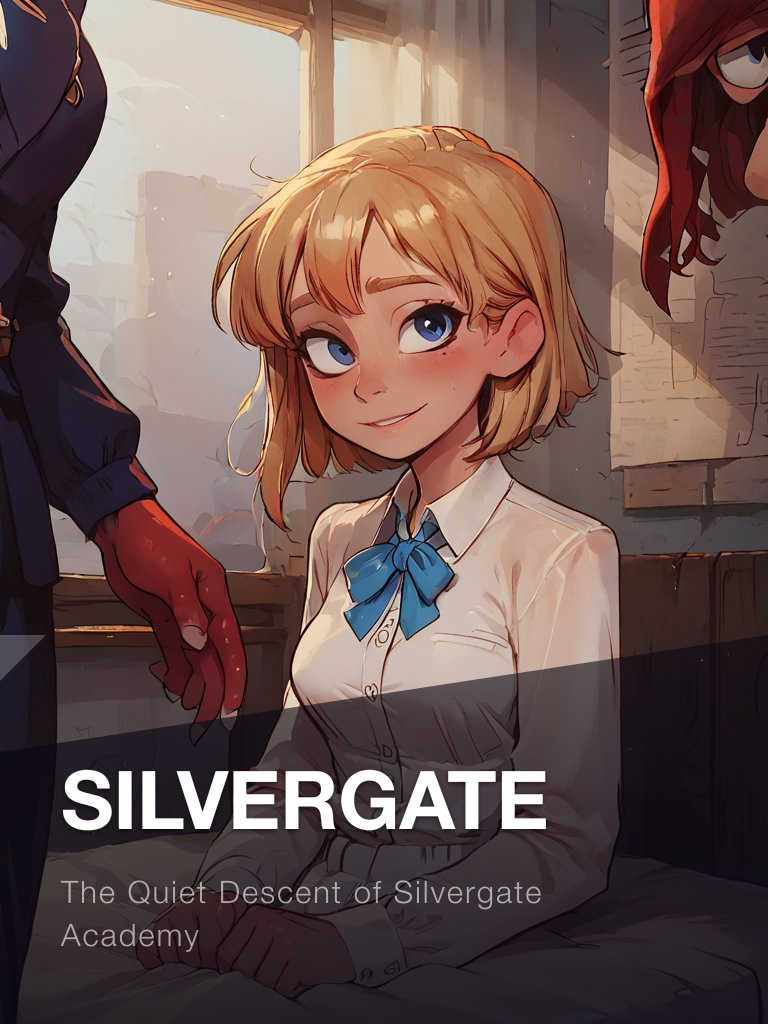

The Quiet Descent of Silvergate Academy
The Quiet Descent of Silvergate Academy - OOC Story
The Quiet Descent of Silvergate Academy
You wake in the body of a disgraced noble heir, broken and abandoned. The only way out is up—through the ruins of someone else's life.
AcademyFantasySlice of LifePossessionRevenge
byOVCS_⑥

The pain arrives first. A precise, grinding ache in your ribs, a constellation of bruises blooming beneath silk sheets. You are in a bed that is not yours, in a body that has been shattered. Yesterday, in the sparring arena at Silvergate Academy, this body's original owner—the arrogant heir to House Valerius—was publicly dismantled by a commoner transfer student. Your mana core is fractured. Your reputation is ash. The one who broke you, a young man named Julian Thorne, is everything you are not: prodigiously talented, effortlessly kind, radiating a light that draws every gaze. Your own fiancée, Ondine Valerius, watched you fall. She did not look away. This is rock bottom. A perfect isolation. But from here, you can see everything. The script has been written, but the ink is not yet dry. You have been given the worst hand in the house, but the game is far from over. The only question is what you will build from the wreckage, and what you will take for yourself.

Choose an opening

The scent arrived first, and it was wrong.
It was lavender and linen, yes, but it was wrong. It was the lavender of pressed sachets tucked into drawers by servants who were paid to care, not to care for you. It was the linen of sheets changed on a schedule, starched and ironed to a stiff, sterile perfection. It held no warmth of a body sleeping, no faint trace of sweat or spilled wine or the particular, private scent a room acquires when a person lives in it. It was a clean, expensive scent, and it was utterly foreign.
The second thing was the pain. It did not announce itself with a shout but with a detailed, meticulous cartography of failure. It was a grinding complaint from your left ribs, a specific, insistent pressure that seemed to speak with each shallow breath: here, and here, and here. It was a dull, hot pulse in your temple, a metronome keeping time with a heartbeat that felt too loud in the quiet. It was a constellation of aches across your shoulders and back, each bruise a dark star in a personal galaxy of humiliation. You lay still, letting the map draw itself across the inside of your eyelids.
You opened your eyes.
A canopy of cream-colored silk hung above you, embroidered at its edges with gold thread in a pattern of interlocking vines. The vines were perfectly symmetrical, unnervingly so. The gold caught the weak morning light filtering through heavy velvet drapes and threw it back in cold, tiny glints. You watched those glints for three full breaths, your chest rising and falling with an effort that felt rehearsed, as if you were remembering how to do it. The silence of the room was not an absence of sound but a presence. It was the thick, velvet silence of a tomb that happened to have very nice furniture.
The memories came then. Not as a flood, not as a tsunami, but as a slow, chilling seepage, like groundwater finding the cracks in a foundation.
Cassian Valerius.
Heir to a waning noble house. The words formed in your mind with the flat cadence of a ledger entry. Eighteen years old. Arrogant. Petulant. Magically mediocre. The kind of young man who wore his lineage like a cloak two sizes too large, trailing behind him, tripping him up. He had a face designed for portraits—sharp jaw, straight nose, dark brows—but in life, it was often arranged into a sneer. It was arranged into a sneer yesterday afternoon.
Yesterday afternoon.
The central sparring pavilion. The sun was high and bright, a mocking, cheerful sun. The polished white stone of the arena floor gleamed, heating the air. The tiered stands were full. Every student in your year was there, a sea of dark academy uniforms dotted with the colored sashes of different houses. The air hummed with a low, eager chatter. They had come to see the spectacle, and Cassian had obliged them.
He had provoked the duel. He had stepped forward, his voice carrying that particular, brittle arrogance, and challenged the new commoner transfer student. Julian Thorne.
You saw him now, in the memory, as clear as the canopy above you. Julian Thorne was standing there, calm as a deep pool. He had startling silver hair that seemed to catch the light even under the open sky. His eyes were a clear, gentle blue. He wore the same uniform as everyone else, but it sat on him differently—it looked like clothing, not a costume. He had listened to Cassian’s challenge, and a faint, puzzled frown had touched his brow, as if he were being asked to explain a simple concept to someone who was willfully misunderstanding it.
It lasted less than two minutes.
Cassian had summoned his mana, a weak, sputtering glow of pale blue around his fists. He’d lunged, a textbook opening gambit taught to noble children in their parlors. Julian had not moved. Not at first. He had watched the approach, his head tilted slightly. Then, with an economy of motion that was almost beautiful, he had sidestepped. His own hand had come up, not in a fist, but with fingers spread. A flash of silver light, pure and bright as a shard of moonlight, had coalesced in his palm. It wasn’t a blast; it was a precise, focused pulse. It had connected with Cassian’s chest not with a bang, but with a crack.
It was a sound that did not just hit the ears. It resonated in the chest cavity, in the teeth, in the bones of the skull. It was the sound of something structural giving way.
Cassian was on the stone. The impact was not graceful. It was a collapse, a folding-in of limbs. The pale blue glow around his hands guttered and died. The silver light from Julian’s hand winked out. Julian stood over him, looking down. His expression was not triumphant. It was concerned. It was pity. That was the worst part, the memory insisted. The pity in those clear blue eyes, sincere and gentle, as he looked at the broken heir gasping on the ground.
A fracture.
Not of the ribs, though there were those too. A fracture deep inside, in the place where magic was born. The mana core. A spiderweb of cracks radiating through a fragile crystal. The crowd’s noise—a collective gasp, then a rising wave of chatter—had sounded very far away.
In the bed, you tried to flex the fingers of your right hand.
They trembled.
It was a fine, barely perceptible vibration, like the very last reverberation of a struck bell. You stared at your own fingers, the nails clean and neatly trimmed, the skin pale against the dark duvet. You willed them to curl into a fist. They did, slowly, stiffly. The tremor ran through the knuckles.
Then you reached inward.
Every student at Silvergate Academy had a sense of it, a background hum, a well of potential. Reaching for it was like listening for your own heartbeat. You reached.
You found a jagged, silent ruin.
Where there should have been a steady thrum, a reservoir of light and power rated at three stars—the bare, embarrassing minimum for a noble heir—there was only a cold, dark shatter. A few faint, dying embers glowed where the cracks were widest, a pathetic, flickering light that barely registered as a single star. One star. You were, magically, a child again. A novice holding a practice wand for the first time, all potential and no skill. The fall from three to one was not arithmetic; it was a cliff face, and you were at the bottom, looking up at a sky that had grown very distant.
You let your hand fall back to the sheet.
Your eyes traced the room. It was large. Dark wood panels covered the walls, carved with geometric patterns. A heavy wardrobe stood against one wall, its doors closed. A desk of the same dark wood sat near the window, its surface empty except for a crystal inkwell and a pen with a silver nib. A single, high-backed velvet chair was pulled close to the cold fireplace. The floor was bare polished oak, save for a single, thick rug in deep blue. It was opulent in the way a museum diorama is opulent: perfectly arranged, devoid of life.
It was a solitary dormitory for a Valerius. A privilege of birth. A gilded cage.
It was also profoundly empty.
No concerned friends lingered by the door, whispering. No servant moved quietly in the corner, preparing a tonic. The door remained shut, a solid slab of oak with an iron latch. You listened. No footsteps in the hall outside. No muffled voices.
Your fiancée. Your cousin. Ondine Valerius.
She had been in the front row of the spectators. You recalled the exact shape of her mouth. It was not a gasp. It was not a hand flying to her lips in horror. It was a faint, cold twist of displeasure, as if she had just witnessed a servant drop a valuable vase. Her grey eyes had watched you fall, and they had held no surprise. Only a kind of severe disappointment, the disappointment of a shareholder reviewing a failing investment. She had turned away before you had even come to a complete stop on the stone.
She would not come.
No one would.
The world had contracted. It was now this bed, this pain, this silent, expensive room, this ruined core. The vast grounds of Silvergate Academy—the Grand Athenaeum with its spire piercing the sky, the bustling refectory, the sparring pavilions where the air crackled with practiced spells, the green hills beyond—all of that was outside. Out there, Julian Thorne was the rising star. Out there, conversations were happening about his stunning control, his humble demeanor, his startling silver hair. Out there, your name was a punchline, a cautionary tale whispered behind hands.
In here, there was only you.
And the dry, clinical observation that settled in the air like dust motes in a sunbeam: rock bottom provides the clearest view of the climb ahead. There are no obstructions down here. No one is looking at you. All eyes are tilted upward, following the light. From this perfect, desperate isolation, you can see every handhold, every loose stone, every shadow in which to wait.
The heavy duvet was a weight across your legs. It was embroidered with the same vine pattern as the canopy, a universe of interlocking gold threads.
What do you do first?
Do you push it back, this weight of privilege and failure? Do you swing your legs—legs that surely must ache, must protest—over the side of the bed and test them against the cold floor? Do you stand, gripping the bedpost, and take the measure of this broken body in the silent room?
Or do you lie still, in the lavender and the linen and the pain, and plan? The script of Cassian Valerius is written in ash. It can be brushed aside. A new hand holds the pen. The ink is not yet dry on the page that comes after the wreckage.
The choice, like the body with its trembling fingers and its silent core, is now yours.
The light through the drapes had grown stronger, a solid bar of pale gold cutting across the foot of the bed and illuminating a swirl of dust in the air. You watched the dust dance in the silence. Then, slowly, you moved your left arm. It felt heavy, disconnected. You placed your palm flat on the duvet, over your chest, where the silver light had struck. You could feel the dull ache of the bruise beneath, the tender protest of the ribs. You pressed down, just a little. The pain sharpened, became specific. It was an anchor.
You left your hand there, feeling the beat of your heart against the pressure. The tremor in your right fingers had subsided. The room waited.
Outside, somewhere far across the manicured lawns, a bell began to toll, marking the first hour of the academic day. Its sound was clear and cold, and it did not stop for you.
Your eyes went to the desk by the window. The crystal inkwell caught the bar of light and fractured it into a tiny, brilliant rainbow on the dark wood. The pen lay beside it, its silver nib pointing toward the door, as if waiting for a hand to pick it up and write a note, a letter, a new set of instructions. There were no books stacked there. No papers. No evidence of a mind at work. It was a desk for show.
A perfect, blank slate.
You listened to the bell. Each toll was a vibration in the quiet. You counted them. Seven. Eight. The ninth bell would be for the change of classes. The world was moving on. Julian Thorne would be walking to a lecture, perhaps surrounded by a small, admiring cluster. Rosalind Fairchild with her kind smile and pink hair might be at his side. Isolde Meridian, aloof and brilliant in her purpled-eyed silence, might glance his way from a distance. Corin Vance would be observing it all from a shadowed archway, sharp-eyed and saying nothing. And Ondine Valerius would be walking somewhere with perfect posture, her mind on lineage, on contracts, on the cold calculus of family reputation.
They were all out there, living the story.
You were in here, in the wreckage. The only character left in this scene.
Your hand still pressed against your chest. The ache was a constant, a companion.
The bell finished. The last echo faded into the thick walls. The silence returned, deeper now, having been measured and found wanting.
You drew a deeper breath, and the complaint in your ribs flared. You held it. Then you let it out, slowly, watching the dust motes swirl in the sunbeam. You moved your right hand again, bringing it up to your face. You studied the palm, the lines there. They meant nothing to you. They were the lines of a stranger.
But the fingers could curl. They could grip. They could pick up a pen.
You lowered your hand. You turned your head on the pillow, away from the light, and looked at the closed door. The iron latch was down. It was not locked from the outside. It was just shut.
It was a door.
You could open it.
Or you could lie here a little longer, and think.
The scent of lavender was beginning to fade, replaced by the older, colder smell of the room itself: wood polish, a hint of damp stone from the fireplace, the faint, metallic tang of the inkwell. The pain was a map. The silence was a teacher. The emptiness was an opportunity.
You closed your eyes. Not to sleep. To see the climb ahead in the dark behind your eyelids. The handholds. The shadows. The loose stones.
When you opened them again, your gaze was clear. You looked at the duvet, at the weight of it. You looked at your own hands, resting on top of it. One still, one trembling faintly.
Then, with a deliberate slowness that was neither weakness nor caution but a kind of ritual, you began to push the heavy fabric aside, your fingers curling into the embroidered vines.

4/42