
Kensington Arms, Unit 4C
Kensington Arms, Unit 4C - OOC Story
Kensington Arms, Unit 4C
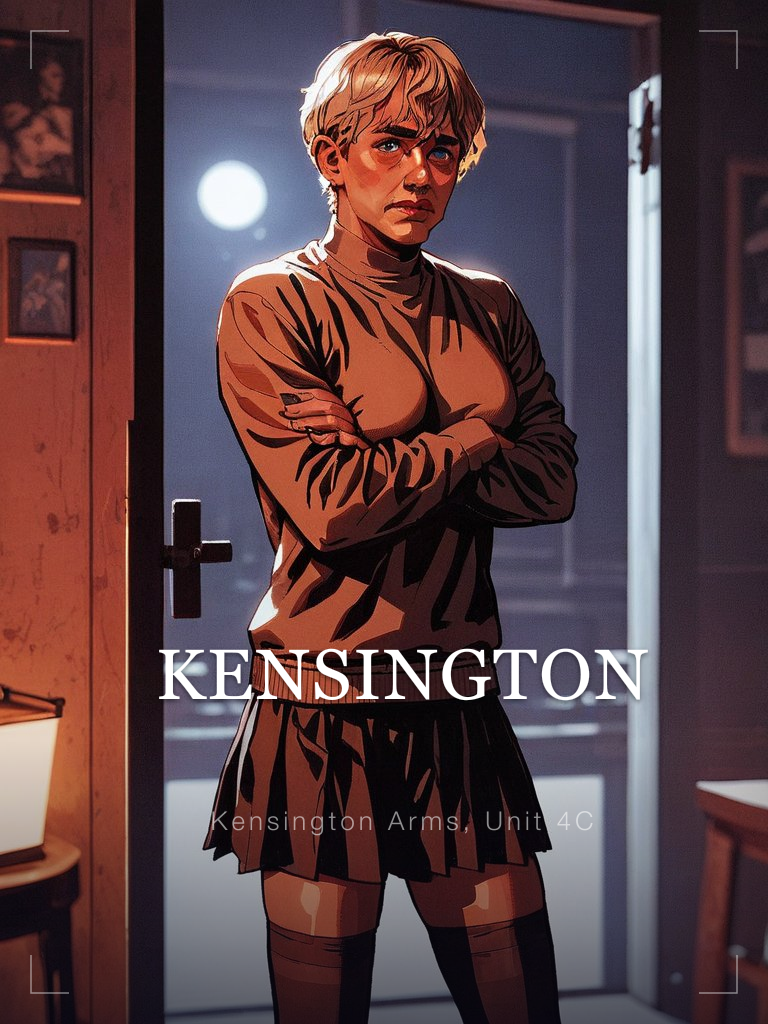
The key turns, but the door is already open. A girl stands framed in the light, her crossed arms the first barrier in a shared apartment neither of you asked for.
romanceslice of liferoommatesyoung adultslow burn
byOVCS_⑥

The lease for Unit 4C at Kensington Arms had your name on it, printed cleanly above the rent due on the first. You’d paid the deposit, signed the paperwork, and carried your last box up the three flights of stairs thinking of the quiet, the space, the singular toothbrush in the holder. It was supposed to be your final year of Westgrove High School answered with a key of your own. She had done the exact same thing. A separate application, a separate check, a separate signature on an identical lease for the same apartment on the same floor. The property manager’s voice on the phone had been a flat, bureaucratic drone: a clerical error, two tenants for one unit, you’ll have to work it out between yourselves or both be evicted. Now you stand in the hallway, your duffel bag digging into your shoulder, looking at the girl who has just opened the door you were about to unlock. Her hair is the colour of honey in the late light from the living room window. Her expression is not one of welcome.

The silence of the fourth-floor hallway at Kensington Arms was a held breath. It smelled of lemon-scented polish that didn't quite cover the mustiness of old carpet and, faintly, of the garlic-and-onion ghosts of a hundred reheated dinners from the units below. Your key was a cold, sharp weight in your palm, its brass teeth freshly cut, a promise made solid. You'd carried the duffel bag up three flights of stairs, your shoulder aching with the proof of your independence: textbooks, a blanket from home, the coffee maker you'd bought with your own money. This was it. Unit 4C. The end of the hall, where the afternoon light from the stairwell window didn't quite reach.
You shifted the bag's strap, the nylon digging a groove into your collarbone. You lifted your hand. The key caught a sliver of the distant window's light, a dull gleam aimed at the deadbolt's dark, welcoming mouth.
The door swung inward.
Not a hesitant crack, but a smooth, decisive arc, as if someone had been waiting on the other side, listening for the scrape of a sole on tile. Light—thick, honeyed, late-autumn light—flooded the dim corridor, painting the scuffed floorboards a sudden, shocking gold. And framed in that doorway, backlit so her blonde hair became a tangled halo against the warm room behind her, stood a girl.
She held the doorknob loosely, her other arm hanging at her side. She wore the crisp uniform of Westgrove's social stratosphere: a black cashmere-blend sweater over a white button-down, a pleated skirt with sharp lines, black thigh-highs. Her face was all clean angles and a placid, unsettling stillness. She wasn't smiling. She wasn't frowning. Her expression was a pure, clinical assessment, the kind you'd give a piece of furniture delivered to the wrong address.
Her eyes, a clear, dispassionate blue, moved. They tracked from your face, down to the key still extended in your hand, over to the bulky duffel bag slumped at your feet, then back up to meet your gaze. She didn't blink. The only sound was the low, persistent hum of the building's ancient furnace somewhere in the walls and the faint, rhythmic tap of a loose blind cord against a windowpane inside Kensington Arms, Unit 4C.
“Let me guess,”
she said. Her voice was a cool, measured alto, each syllable placed with deliberate precision, like stones set in a mosaic.
“You're here for Kensington Arms, Unit 4C.”
It wasn't a question. It was a coroner's report. She didn't uncross her arms from beneath her chest, a barricade of knit wool and adolescent authority. She simply stood there, occupying the exact center of the doorway, a human threshold.
Past her shoulder, you caught a glimpse of Kensington Arms, Unit 4C. A slice of beige wall. The worn brown leather arm of a sofa. A window where the dying sun caught the drifting motes in a column of gold, highlighting the dusty slats of a half-closed blind. You'd stared at the grainy listing photo for hours. You'd already mentally placed your desk under that window, your books on the shelves that weren't in the picture but you were sure were there. You'd imagined the singular silence of your own refrigerator humming in the night.
The hallway smelled of polish and ghosts. The girl's perfume was something clean and expensive, cutting through it all.
And it was her apartment, too. The flat, defeated voice of the property manager, Mr. Henderson, echoed in your memory:
A clerical oversight. Two signed leases. Legally binding. You'll have to cohabitate or mutually terminate, with penalties.
The reality, which had been an abstract phone call and a knot of frustration in your stomach, crystallized here in this shared square foot of linoleum. Two keys. One door. Currently open.
She waited. The silence wasn't empty anymore; it was charged, a wire strung taut between you. You could feel the weight of your bag, the cold metal of the key, the dryness in your throat. You could speak first, offer your name like a flag planted in disputed soil. You could step forward, forcing her to either give ground or make physical contact—a shove, a standoff. You could simply raise your key, let the afternoon light catch the brass, a silent exhibit in the case of your rightful claim.
She tapped a single finger against her opposite elbow, a slow, patient metronome.
“I'm Livia Vance,”
she said finally, when the silence had stretched to its breaking point. She didn't offer a hand.
“I hold the lease for this unit. Effective October first.”
Her gaze dropped to your duffel again, then lifted.
“I was under the impression I was leasing a single-occupancy residence. The management seems to have a different interpretation.”
Livia Vance, backlit, a silhouette of ownership.
You could see the details now that your eyes had adjusted. A single, fine blonde hair had escaped her ponytail and lay against her cheek. The collar of her white shirt was perfectly straight, but the very bottom button of her sweater was undone. She shifted her weight, a subtle movement from one hip to the other, and the floorboard beneath her creaked a specific, familiar protest. It was the sound of someone who had already learned the language of this space.
“They called me too,”
you said, and your own voice sounded rougher, less certain in the polished air she'd created.
“I assumed.”
Her eyes didn't leave yours.
“The question, then, isn't about validity. It's about solution. They've presented us with two unpalatable options. I find neither acceptable.”
A bus rumbled past on the street four stories below, a distant vibration through the brick. The golden light in Kensington Arms, Unit 4C was deepening to orange, painting long shadows across the slice of living room you could see. On the wall, near the window, was a framed print—something abstract and geometric. She'd already hung art.
“So you're just… living here,”
you said.
“I moved in yesterday. My things are in the bedroom.”
She said it without emphasis, a simple statement of fact that was also a territorial claim. The bedroom. The only bedroom. The sofa in the living room behind her, you now noticed, was conspicuously bare of pillows or blankets.
The living room, bathed in late light, a space already curated.
You adjusted your grip on the duffel strap. The movement felt loud.
“I have a lease, too. Also effective October first.”
“I don't doubt it.”
For the first time, her mouth tightened, a faint, almost imperceptible thinning of her lips. It was the only crack in the placid surface.
“This is an inefficiency. A significant one. My senior year workload requires a controlled environment. Undisturbed quiet.”
She said it as if reading from a prepared list of tenant rights.
“Mine too,”
you said, and the words came out with more edge than you intended.
She heard it. Her head tilted a fraction, a birdlike reassessment. The loose hair brushed her jawline.
“Then we have a problem that transcends property management.”
She finally moved, not to step aside, but to shift her hand from the doorknob to the edge of the doorframe, her fingers curling around the wood. A possessor's grip.
“What's your name?”
You told her.
“{{user}},”
she repeated, tasting the syllables. She gave a small, single nod, as if filing it away under a heading.
“Well, {{user}}. You're standing in the hall with a bag. I'm standing in the doorway of Kensington Arms, Unit 4C I'm paying for. The sun is setting. The municipal bus line stops running at eleven. What, precisely, is your proposed next step?”
Her question hung in the air, precise and lethal. It wasn't about feelings or fairness. It was a logistical challenge, coldly issued. Behind her, in the deepening orange glow of Kensington Arms, Unit 4C, a radiator ticked once, twice, then began a slow, metallic hiss. She didn't turn to look. She knew the sound. It was hers.
You could push past her. You could drop your bag right there in the hallway and sit on it. You could turn around and walk back down the three flights of stairs, the key burning a hole in your pocket. But the deposit. The lease. The look on her face, which wasn't cruel, just immovable, like a closed gate.
The furnace hummed its endless note. The blind cord tapped.
Tap. Tap. Tap.
The brass key, warm now from your grip, a claim and a curse.
“My proposed step,”
you said, the words forming slowly,
“is to cross this threshold.”

4/48