
Ironwood Academy
Ironwood Academy - OOC Story
Ironwood Academy
The polished granite plaza hums with new cadets. Beyond the gates, a wall of names stretches into the distance, a silent promise.
fantasyisekaimechaacademymilitary
byOVCS_⑥

The air smells of ozone and wet granite. You stand in the shadow of Ironwood Academy’s gatehouse, a vaulted arch of riveted steel that frames a plaza teeming with new arrivals. Uniforms are crisp, luggage wheels click over hexagonal pavers, and a low-frequency thrum vibrates up from the subterranean hangars. Everyone is trying not to look at the Memorial Wall—a sheer face of black basalt etched with thousands of names, each one a pilot who didn’t graduate. For the next four years, this is your home. You will learn to pilot a Titan, a walking fortress of alloy and wrath, against creatures that level cities. You will choose a chassis: the swift Raptor, the stalwart Goliath, the balanced Aegis, the surgical Valkyrie, or the overwhelming Colossus. Its AI, called an Echo, will learn your habits, your fears, the shape of your thoughts. But first, you must find your barracks. The orientation bell rings in fifteen minutes. Your new student ID rests in your palm, its holographic seal catching the flat grey light. {{user}}, what does it say?

Choose an opening

The scale was a physical weight. It wasn’t the towers of glass and steel, nor the skeletal gantries where maintenance crews clung like mites to the silent, hundred-foot Titans in their bays. It was the sheer volume of nothing—the Grand Plaza, an ocean of grey granite so vast it drank sound. Your footsteps echoed, a lonely percussion against the stone. Hundreds of other first-years milled in a murmuring tide of navy jackets and charcoal trousers, a few clutching duffels, most staring at the slates in their palms as if they held holy writ. The air tasted of industrial solvent and the distant, metallic tang of ozone from the live-fire ranges beyond the cliffs.
To your left, the plaza fell away into a canyon of hangar bays, their doors sealed like the jaws of sleeping giants. To your right, the academic spires climbed, their windows reflecting the flat, pearlescent grey of the sky. And directly ahead, cutting across the entire northern edge as if placed there by a god with a grudge, was the Memorial Wall. It wasn’t something you looked at. It was a presence that watched you. Fifty feet of polished black basalt, running the length of three football fields. From this distance, the engraved names were just a textured blur, a shadow on stone, countless and anonymous. Cadets streamed past it, a river of navy avoiding a monolith. Most did not turn their heads. A single figure in a faculty greatcoat stood before it, a statue of black wool against the black stone, perfectly still.
The orientation bell was a clean, digital chime that sliced through the murmur. It rang across the plaza once, twice, a third time—a triple beat that meant
move
. Above the main gatehouse, a holographic countdown flickered to life in stark, blood-red numerals: 14:59. Your dormitory number was printed on your new student ID. The plastic card was warm from your grip. You flipped it over. The holographic seal of Ironwood Academy—a heavy gear encircling a gnarled, towering oak—shimmered in the damp light. Your name. Your age. Your nationality. Your photograph, taken this morning with a blank wall behind you. It was all there. The official record of who you were, a bookmark placed before the academy began to rewrite you.
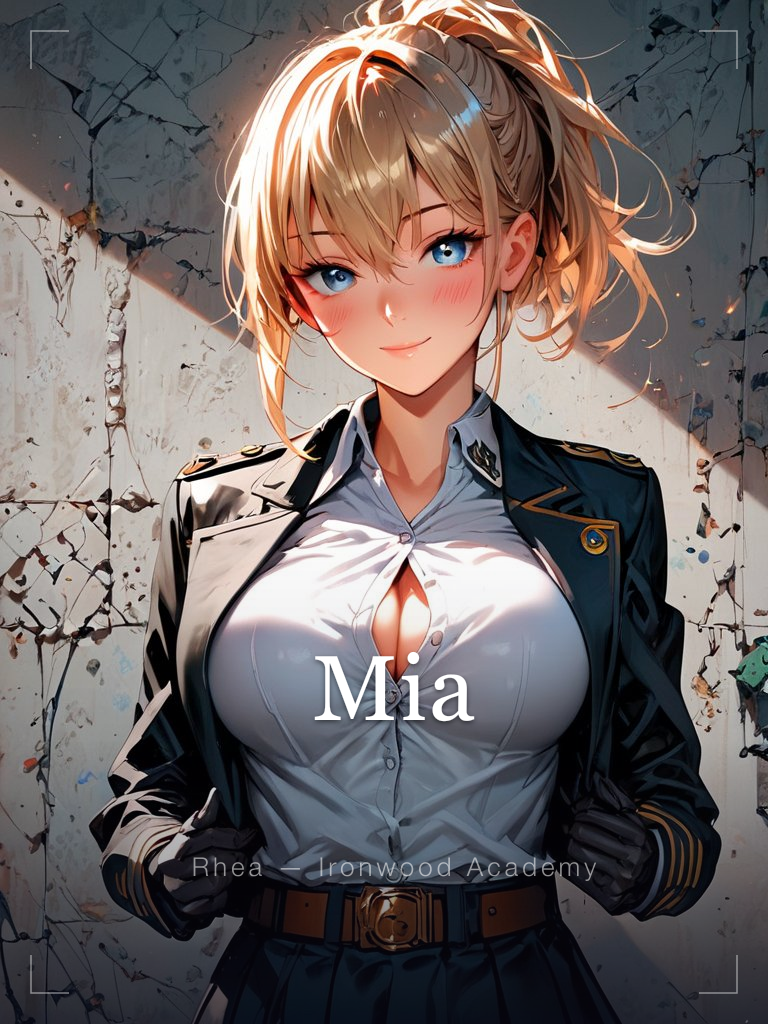
A shoulder bumped yours, hard, without apology. You caught a flash of blonde hair tied in a severe, practical ponytail, blue eyes that didn’t glance back.
“Move or get left behind,”
she said, her voice crisp, already carving a path through the crowd toward the gatehouse.
Her name was Mia Ortiz. You knew that because you’d seen the roster, the same as everyone else. Top of her prep-school class, youngest qualifier for the Valkyrie aptitude trials, a reputation for competitive fire that bordered on aggression. She walked like she already owned the gantries, her back straight, her stride eating the distance.
Around you, the crowd began to coalesce into a directed flow. The intimidating space now had a current, and you were caught in it. A girl with dark skin and a smile that seemed to soften the granite around her was adjusting the knot of her tie, her jacket worn open against regulation. She caught your eye for a half-second, the smile flickering like she was about to say something, then thought better of it. Rhea Valen. Aegis-track. She turned to watch Mia’s retreating back, her expression unreadable.
Further off, leaning against a concrete bollard as if bored by the entire spectacle, was a girl with cropped orange hair and a dusting of freckles across her nose. Kai Hartnell. She was spinning a multi-tool on her finger, her green eyes scanning the crowd not with awe, but with a restless, calculating impatience, already picking out the slow ones, the nervous ones, the ones who’d clog the simulators.
And near the edge, where the plaza met the first hangar canyon, stood Leona Ashburn. Her long white hair was bound in a severe braid that fell like a plumb line down her back. She wasn’t looking at the crowd or the countdown. Her grey eyes were fixed on the sealed hangar doors, on the silhouette of a Goliath just visible behind the reinforced glass. Her hand, at her side, kept forming a fist, then releasing it.
The red numbers blinked: 14:30.
You looked back at your ID. The plastic edge was sharp against your thumb. The dormitory number glowed. Barracks 7, West Quadrant. The path branched here: a wide concourse led left, toward the residential sectors dug into the cliffs. A narrower, older path of worn flagstones led straight ahead, skirting the base of the Memorial Wall. And there was the main thoroughfare, where Mia Ortiz had already vanished into the stream of cadets funneling toward the gatehouse and the orientation hall beyond.
A voice, low and measured, came from your right. Rhea Valen had closed the distance, her hands now in her pockets.
“They say if you walk the length of the wall before orientation, you can hear them,”
she said, not looking at the basalt.
“The Echoes of the Titans whose pilots didn”
t make it back. The neural ghosts.’ She shrugged, the gesture almost delicate.
“Probably a story to keep first-years from being late.”
But she didn’t move toward the gatehouse either. She was waiting, her warm brown eyes holding a question she wouldn’t voice.
From her bollard, Kai Hartnell snorted, loud enough to carry.
“Ghosts. Please. The only thing you”
ll hear over there is your own stomach rumbling.’ She snapped the multi-tool closed and pocketed it.
“The real show”
s in the sim pits. I heard they’re running a live Raptor course demo for the top fifty scorers on the pre-entrance exam. First come, first served.’ She pushed off the bollard, already moving with a quick, darting energy that parted the crowd differently than Mia’s command. She was heading for a service tunnel, a shortcut known only to those who’d done their homework.
Leona Ashburn finally moved. She turned from the hangar, her gaze passing over you, over Rhea, over the dispersing crowd. She didn’t speak. She just began to walk, not toward the dorms or the gate, but toward the flagstone path that led along the base of the Memorial Wall. Her steps were deliberate, heavy on the old stone. She didn’t look back.
The countdown blinked: 13:45.
The faculty member by the wall finally turned. It was a woman, her greatcoat hanging open to reveal the silver oak-leaf cluster of a senior instructor on her lapel. Her face was lined, her brown hair streaked with grey and tied back loosely. She watched Leona’s retreating back for a long moment, then her eyes swept the plaza, landing on you, on Rhea, on the thinning groups. Her expression was neither kind nor cruel. It was weathered, like stone smoothed by a constant wind.
Rhea shifted her weight.
“Well,”
she said softly.
“We”
re all going to be squadmates, one way or another. They’ll assign us based on today.’ She finally looked at you.
“The way you walk in sets the tone.”
She left the choice hanging in the ozone-tinged air.
To the left, the dormitories awaited—a chance to stow your gear, to find your bunk, a few minutes of quiet before the storm. Straight ahead, the flagstone path and the shadow of the Wall, where Leona’s figure was growing smaller, a solitary silhouette against the impossible black. To the right, the main thoroughfare and the gatehouse, the sanctioned path, where you would join the herd and be processed.
And there was Kai’s disappearing back, veering into the service tunnel—a gamble, a shortcut, a defiance of the planned route.
Your ID card dug into your palm. The holographic oak tree seemed to pulse faintly with the rhythm of your own heartbeat.
Rhea was still waiting, her head tilted slightly. The digital chime rang out again, a single, insistent note. 13:00.
“So,”
she said, her voice barely above the rising murmur of the crowd.
“Which way does your card point you?”

4/54