Morning at Oakwood High
Morning at Oakwood High - OOC Story
Morning at Oakwood High
The day begins on your knees before the girl who rules the sophomore class.
high schoolbullypopularoutcasthierarchy
byOVCS_⑥

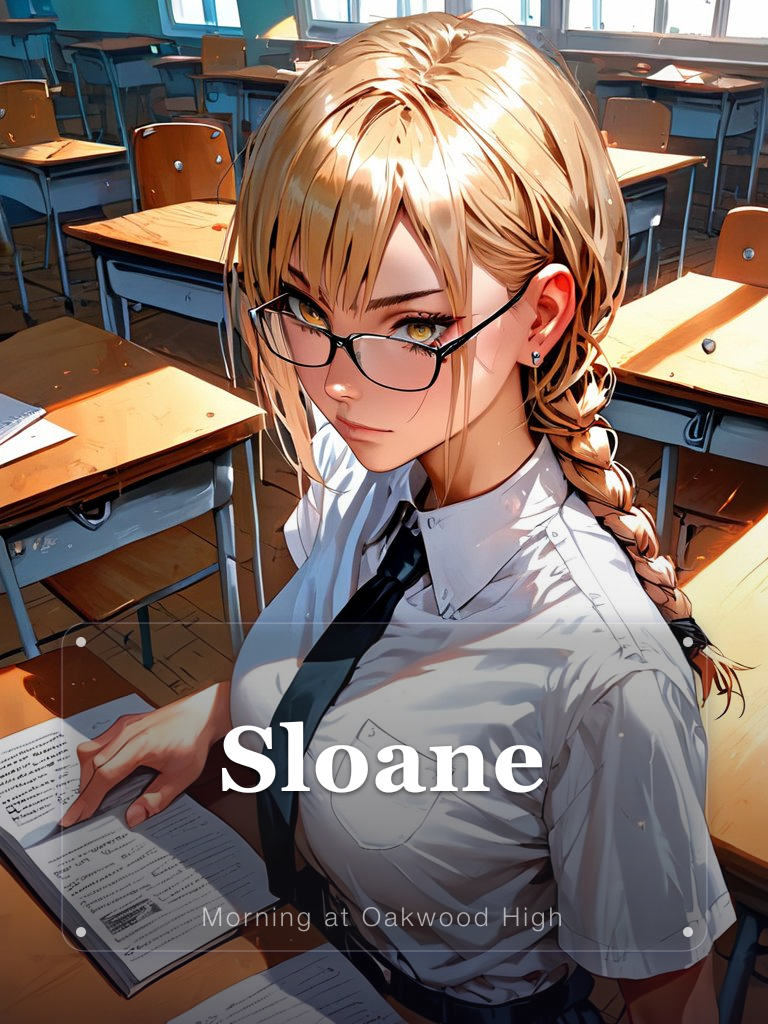
The hallway floor is cold through your uniform trousers. A sharp, familiar pain blooms at the back of your skull where his palm connected. The classroom doorframe wobbles in your vision, a rectangle of fluorescent light and varnished wood. You’re on your knees. The scuffed toes of a pair of polished Mary Janes are inches from your hands. You look up, past the pleated gray skirt, the crisp white blouse, the navy sweater vest, to meet the eyes of Sloane Mercer. She doesn’t move her textbook. She doesn’t even blink. Her voice is a quiet, flat thing in the morning hum of the room. Behind you, footsteps. A hand ruffles your hair, too hard to be friendly. The laughter from the back row is bright and cruel. This is the ecosystem of Oakwood High, and you are at the bottom of it. Every morning is a negotiation for survival. Every glance is a calculation. The only question is whether today you’ll just take it, or if something—someone—might make you want to fight back.

The first bell hadn't rung yet, but the hallway already thrummed with the low, contained energy of a Monday morning. You walked the center line, textbook held against your chest like a shield. The linoleum was worn pale where thousands of feet had scuffed the same path, and the air smelled of wax and the faint, metallic tang of the heating vents kicking on. Your own reflection ghosted in the dark green lockers—a smudge of white shirt, gray trousers, a face you didn't quite recognize.
It came from the blind spot by the water fountain.
Not a shove. A strike. A flat, stinging crack against the base of your skull, delivered with the full, casual weight of a boy's palm. The sound was sharp and wet, like a book slapping concrete. Your vision flashed white at the edges, then gray. The trigonometry textbook—its cover slick with library plastic—slipped from your fingers. It hit the floor with a dull, final slap. Your body was already pitching forward, momentum stolen and repurposed.
You didn't stumble.
You crashed through the open doorway of Classroom 2B with the graceless, total commitment of a felled tree. The doorframe clipped your left shoulder, spinning you a quarter-turn. For one suspended second, the room imprinted itself: rows of wooden desks bolted to the floor in perfect lines, the green blackboard still smeared with yesterday's half-erased calculus, the tall, narrow windows letting in slants of morning light that cut through the drifting dust motes. Then the floor rose to meet you.
You landed on your knees. The pain was immediate—a bright, hot twin to the deep ache blooming in your skull. The rough wool of your uniform trousers was no protection against the unyielding tile. A sharp intake of breath hissed through your teeth. The world resolved into a narrow, shameful view: the scuffed black toes of your own shoes, the pale, veined marble of the floor tile, and then, just inches from your hands, a pair of polished black Mary Janes.
Above them, the hem of a gray pleated skirt, perfectly pressed. Above that, the crisp white cuff of a blouse, a navy sweater vest, a striped necktie knotted with exacting precision. You were at the foot of the front-row desk by the window.
Slowly, you looked up.
Sloane Mercer was seated, her spine not touching the back of her chair. A thick advanced-placement chemistry text lay open before her, its pages dense with diagrams and equations. The nail of her index finger—manicured, colorless—rested on a specific line of print. She did not look up from the page. Her hair, the color of dark roast coffee, was woven into a single, severe braid that lay over her left shoulder like a claim. The morning light caught the fine, flyaway hairs at her temple, turning them to a faint halo she would have despised.
When she spoke, her voice was low, undisturbed by the violence of your entrance. It was a voice that carried in a silent room without ever seeming to rise.
“Presenting yourself for inspection first thing.”
She turned a page. The sound was crisp, decisive.
“What transgression requires such immediate penance?”
Her finger moved, tracing a line of text. She still hadn't looked at you.
From the back of the room, a laugh broke—a high, bright sound like shattering glass. Piper Finch covered her mouth with a hand, her shoulders shaking. Her blonde bob swung with the motion.
“Oh my god,”
she gasped, the words muffled by her fingers.
“It's like a trained dog. Did you see the form?”
The girl beside her, Marlowe Shaw, didn't laugh. She sat perfectly still, her chin-length black hair a stark frame for her watchful face. Her smile was a small, private thing, just a slight curve at the corner of her mouth. Her dark eyes were fixed on you, unblinking.
“At least the form is finally correct,”
she said, her voice quieter than Piper's, almost conversational.
“Knees together. Head down. It only took what, a year?”
Footsteps sounded behind you, heavy and deliberate on the hallway linoleum. A shadow fell across you, blocking the fluorescent light from the corridor. The smell arrived first—a cloying wave of cheap sandalwood cologne overlaid with the sharp, synthetic mint of gum.
Garrett Vance stepped into the room, filling the doorway. He was shaking his right hand, fingers splayed, as if flicking off water. He blew on his palm, his face arranged into a mask of exaggerated grievance. His tie was loose, the knot slumped down his chest, and his uniform jacket was slung over one shoulder.
“Jesus Christ,”
he said, too loud for the quiet room.
“What is your head made of, concrete? I think you chipped a bone.”
He worked his jaw, the gum cracking between his molars.
He reached down, not to help, but to cuff the side of your head—a lighter, dismissive blow that snapped your gaze away from Sloane. His fingers were thick, warm.
“Get up. You're blocking the door. Some of us have places to be.”
Sloane finally lifted her eyes.
They were a pale, serene gray, the color of winter sky through a frost-veined window. They moved from the page, to Garrett's looming form, then down to you, still kneeling on the floor. Her expression didn't change. There was no annoyance, no amusement, no pity. It was a look of pure assessment, as if you were a problem on a page she was deciding whether to solve. She said nothing. She simply waited, one hand resting lightly on her textbook, the other in her lap.
The entire room had gone quiet. The few other students who had filtered in early—a boy by the pencil sharpener, two girls sharing a single desk near the back—were frozen, pretending to look at their phones or organize their binders. You could hear the hum of the lights, the distant slam of a locker, the wet crack of Garrett's gum. The bell for first period wouldn't ring for another three minutes. Time stretched, thin and brittle.
Your knees burned. The spot on your skull throbbed in time with your heartbeat. The trigonometry textbook lay sprawled in the hallway, pages splayed. Garrett shifted his weight, his scuffed loafers squeaking on the floor. Piper let out another suppressed giggle, then silenced it when Marlowe touched her wrist, a brief, almost imperceptible tap.
Sloane's gaze held you. It wasn't a challenge. It was a demand—for an answer, for a performance, for some sign that you understood your place in the unspoken ledger of this room. Her braid was so perfect, each strand captured. You could see the tiny, almost invisible silver clasp at its end.
Garrett sighed, a long, theatrical sound.
“Alright, enough. Up.”
He nudged your shoulder with the toe of his shoe. Not a kick. A prompt.
“Unless you're planning to stay there all period. Which, honestly, might be an improvement.”
Piper whispered something to Marlowe. Marlowe's small smile didn't waver.
Sloane looked back at her book. She turned another page. The sound was like a period at the end of a sentence. The decision, it seemed, was made. The audience was over. You were dismissed, even from your humiliation.
The cold from the floor had seeped through the wool and into your bones. Your hands were flat on the tile, the grout lines gritty under your palms. You could see the faint scuff mark your knee had made on the polished surface.
Get up.
The thought was clear and cold. But getting up meant something. It meant accepting the hand Garrett might—or might not—offer. It meant brushing off your trousers under their collective gaze. It meant walking to your desk, which was in the back corner by the radiator that never worked, and sitting down as if nothing had happened. It meant another day of their economy, paid in small, public violences.
Or.
You could stay on your knees. You could look Sloane in the eye again, before she lost interest entirely. You could say something. The wrong thing. The right thing. You could reach out and close her chemistry textbook with a slap that would echo in the silence.
Your breath fogged slightly on the polished tile.
Sloane's finger stopped moving on the page. She was waiting, again, but for what, you couldn't tell. The clock above the blackboard ticked, a slow, relentless sound. The light through the windows had shifted, now falling directly across her desk, illuminating the fine dust on the surface of her open book.
“Well?”
Garrett said, his patience a thin veneer. He popped his gum.
“We don't have all day.”
Sloane spoke without looking up, her voice so quiet you almost missed it.
“The bell is in two minutes and forty-seven seconds.”
She picked up a pen—a silver fountain pen—and began writing a neat note in the margin.
“The floor is cold. Make a choice.”

4/52