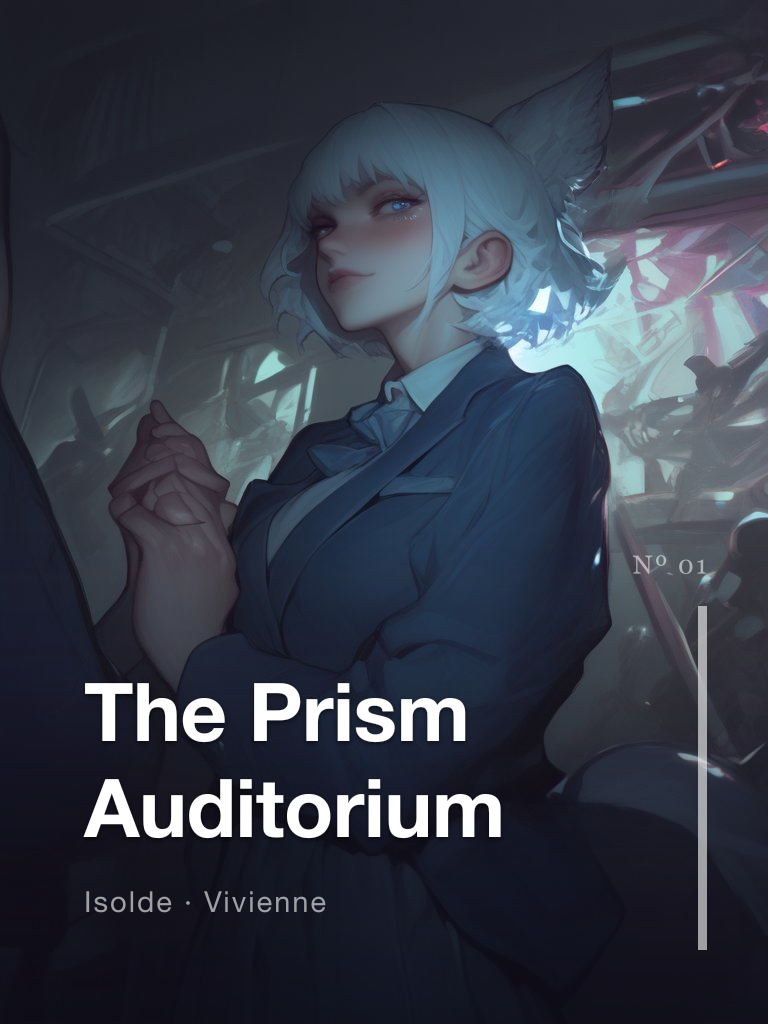

The Prism Auditorium
The Prism Auditorium - OOC Story
The Prism Auditorium
At the psychic aptitude ceremony, an heir of frost and a bored noble await the surge of latent power.
AcademySchool LifeSupernaturalSlice of LifePsychic Powers
byOVCS_⑥

Cold March light filters through the crystalline panels of the Prism Auditorium, catching on the fine frost that drifts from Isolde Sterling's motionless hands. She watches the stage where Professor Althea Vance raises her arm, the air thickening with the hum of awakening machinery. Beside her, Vivienne Croft yawns into her palm, her odd-colored eyes—one amber, one violet—scanning the crowded general seats for someone, anyone, interesting enough to merit her attention. The academy's annual intake ceremony is a ritual of lineage and latent power. Here, the scions of psychic dynasties sit apart from the scholarship prodigies, their family names etched into the polished obsidian benches. Today, the Recognition Circuit will map the psychic potential of every first-year student, drawing blue geometric light from the floor to the vaulted ceiling. For {{user}}, standing among the hopefuls in the general section, the air crackles with anticipation and the sharp scent of ozone. The machine's whir grows louder, and the first threads of luminous energy begin to weave through the hall, searching for a spark to measure.

Choose an opening

The silence in the Luminous section was a polished, crystalline thing. It had weight and temperature, a presence that settled like hoarfrost over the row of obsidian benches. Isolde Sterling did not fidget. Her hands rested in her lap, pale as alabaster against the dark wool of her skirt, and from her ring and little fingers, a fine, constant mist of frost drifted upward, evaporating before it could dust the bench beside her. She kept her gaze fixed on the distant stage, where the morning light, fractured by the auditorium’s crystalline ceiling panels, fell in soft, directionless spears. One of them caught the silver pin in her white hair, turning it into a cold, bright star.
On the stage, Professor Althea Vance adjusted the microphone stand. The sound was a dry, precise click that echoed once in the vastness of the Prism Auditorium and was swallowed by the waiting air. Her posture was a study in perpendiculars, her slate-gray suit perfectly pressed, her silver-streaked black hair pulled back so tightly it seemed to stretch the skin at her temples. She did not look at the students yet. She was calibrating the moment, the way one might check the tension of a bowstring.
Beside Isolde, Vivienne Croft exhaled. It was not a sigh of impatience but a deliberate release of breath, a venting of pent-up, bored energy. She was slouched so deeply into the obsidian bench that her spine seemed to have abandoned its duty. One arm was slung over the backrest, the sleeve of her unbuttoned academy blazer crumpling against the polished stone. Her heterochromatic eyes—one a warm, predatory amber, the other a cool, analytical violet—drifted like searchlights over the crowded General section. She watched the shifting mass of bodies, the nervous adjustments of collars, the way hands twisted in laps or tapped against thighs.
“The intake this year is… robust,”
Isolde murmured. Her voice was so soft, so deliberately measured, it barely disturbed the frost-laden air around her hands. It was a voice meant for ledgers and lineage charts.
“I find myself concerned. Can the academy”
s foundational protocols withstand such a volume of untested potential? It seems a precarious equilibrium.’
Vivienne’s lip curled. Not in a smile. It was a twitch of contemptuous amusement.
“Protocols.”
She drew the word out, languid and mocking.
“You sound like the opening chapter of the student handbook, Sterling. All this order and measurement. It”
s a form of preservation. For things that are already dead.’ She shifted, the fabric of her blazer whispering a dry protest.
“Out there,”
she said, nodding her chin toward the sea of wooden benches,
“is what matters. Raw power. Instinct. The kind that doesn”
t ask for permission.’ Her amber eye gleamed.
“With a crowd this thick, there”
s got to be at least one person in there worth the effort of dismantling. Someone who doesn’t know the first rule of the dance.’
Her gaze, sharp as a shard of glass, settled not on a face but on a space—a gap between two anxious scholarship students, perhaps where {{user}} stood. She held the look for three long seconds, as if marking a spot on a map.
Isolde did not turn her head. She felt the cold in her fingertips intensify, a subtle, controlled response to the provocation. Her family’s legacy was not dead; it was suspended in ice, waiting for the right moment to thaw into glory. She would be that moment.
The obsidian benches held their silent, privileged vigil, separated from the general seats by nothing more than a low railing of polished silver, yet the divide felt continental.
On the other side, the air was different. It carried the faint, acrid scent of nervous sweat undercut by the clean, metallic tang of ozone seeping from the floor’s awakening silver conduits. It hummed with a low-grade psychic static, the unconscious leakage of a hundred anxious minds. Lena Gray wrinkled her nose, her prominent grey wolf ears flattening briefly against her tangled mane of hair. A low, almost inaudible growl vibrated in her throat.
“Too many,”
she muttered, not to anyone in particular. Her luminous golden eyes scanned the periphery, not making contact.
“Scents all mixed up. Static. It itches. Like wool on sunburn.”
She sat hunched forward, elbows on her knees, a live wire of tense readiness. Every flicker of light from the crystalline ceiling made her ears twitch.
Beside her, Leo Stone sat as if welded to the back of his polished wooden seat. His spine was a straight line, a rod of iron will. He wore his one good suit—a black jacket slightly too large in the shoulders, bought for a funeral two years prior—over his crisp white academy shirt. His hands were clenched into fists on his knees, the knuckles standing out like pale marble islands. His gaze was fixed, unblinking, on the distant, ramrod-straight figure of Professor Althea Vance. This was not just a ceremony; it was a gauntlet thrown down by his own life. The Recognition Circuit was a verdict. It would measure the flicker of power a state scanner had detected in a boy from a non-psychic household, a boy who had practiced focusing his will on stopping rain droplets in mid-air until his temples throbbed. It would pronounce his right to be here.
“I am ready,”
he said. The words were not for Lena. They were a vow spoken into the charged air, each syllable forged in private determination.
“I will prove it. Here. To them.”
A few nearby students glanced over at the quiet intensity of his declaration. One young woman with fiery red hair smirked and looked away, whispering to her friend. Another, a tall boy with nervous hands, met Leo’s eyes for a second and quickly looked down at his own shoes. The dismissal was a physical pressure in the air, but Leo Stone did not flinch. He absorbed it, and his resolve hardened into something sharper.
On the stage, Professor Vance lifted her hand. It was not a dramatic gesture. It was an instruction, clean and economical, like the closing of a switch.
The response was immediate. A deep, resonant whirring awoke from beneath the polished granite floor, a sound felt more in the teeth and the bones than heard by the ears. It climbed in pitch and volume, a mechanical giant drawing a first, waking breath.
From the intricate silver inlays that mapped the auditorium floor, threads of brilliant blue energy erupted. Not flames, but something cleaner and more intelligent—psychic particles given visible form. They spiraled upward in graceful, seeking arcs, like vines growing toward the sun at a thousand times normal speed. They touched the crystalline panels of the high ceiling and branched, fractalizing, weaving a vast, glowing net. It was the Recognition Circuit, a three-dimensional lattice of light and intent, descending slowly, deliberately, to envelop the entire hall. Its geometric patterns pulsed with a soft, humming luminescence, a beautiful and terrifying instrument designed to find and measure the latent spark within every student present.
The light played over faces in the General section—washing over Lena’s scowl, glinting in Leo’s determined eyes, highlighting the anxious bite of a lip here, the hopeful upturn of a chin there. It reached the low silver railing, and for a moment, the divide between Luminous and General was bridged by pure, neutral radiance.
In the Luminous section, the cold blue light mingled with the ambient chill around Isolde Sterling. The frost from her fingers swirled in the new energy currents, creating tiny, sparkling vortices that died as soon as they were born. She watched the Circuit descend, her glacial blue eyes reflecting its intricate paths. This was the system. This was the protocol in its purest form. It would categorize, quantify, and place everyone in their proper order. A part of her, small and deeply buried, wondered what it would feel like to be measured by something so utterly impartial.
Vivienne Croft, meanwhile, had finally sat up. The bored languor was gone, replaced by a focused, predatory stillness. Her odd eyes tracked the movement of the light, the amber one warm with anticipation, the violet one coldly calculating. She was not looking at the Circuit itself, but at the reactions it provoked in the crowd below. She was hunting for a flinch, a gasp, an uncontrolled surge of power—a sign of the worthy opponent she craved.
“Look at them,”
Vivienne said, her voice a low, interested drawl.
“Like rabbits in a field when the hawk”
s shadow passes over. All that raw potential, and most of them are just trying not to piss themselves.’
Isolde’s lips tightened almost imperceptibly.
“Control is the first mark of a true psychic. Fear is a solvent. It dissolves discipline.”
“Discipline is what you build after you survive the fear,”
Vivienne countered, her gaze still roaming.
“If you survive.”
The humming of the Circuit shifted, deepening. The geometric patterns began to rotate slowly, aligning. The measurement was about to begin. The blue light grew denser, falling over the students like a gentle, probing mist. It sought the unique psychic signature of each individual, the frequency of their soul’s power.
In the General section, Lena Gray snarled, a short, sharp sound. She clapped her hands over her wolf ears as the psychic static amplified, the Circuit’s scanning field grating against her enhanced senses like a file on metal.
“Make it stop,”
she growled through gritted teeth, her golden eyes squeezed shut.
Leo Stone did not cover his ears. He opened his hands, palms up on his knees, and stared straight into the heart of the descending light. He welcomed it. He imagined his will as a shield, polished and unwavering.
Measure me
, he thought, a silent challenge.
I have nothing to hide but everything to prove.
The light touched him, and for a second, his outline seemed to sharpen, to burn with a faint, inverse shadow of determination.
Professor Vance’s voice, amplified and perfectly modulated, cut through the resonant hum. It was not loud, but it carried to every corner of the Prism Auditorium, a needle of sound in the tapestry of light.
“The Recognition Circuit is now active. It will attune to each of you. Do not resist. Let it map your potential. Your designation—Luminous or General—is not being reassessed today. Your capability is.”
A ripple went through the crowd. A designation. A capability. The words hung in the ozone-thick air.
Vivienne Croft’s eyes finally stopped their restless search. They locked onto a single point in the General section, a focus so intense it was like a physical touch. A slow, genuine smile touched her lips, the first of the morning. It was not a pleasant sight.
“There,”
she whispered, more to herself than to Isolde. Her voice held the quiet satisfaction of a collector finding the one piece missing from her set.
“Did you see that? A flicker. Not fear. Not control. Something else entirely.”
Isolde followed her gaze, her own expression unchanging, a mask of frost and porcelain. She saw nothing unusual—just another student among many, standing where {{user}} stood. But Vivienne’s certainty was a contagion. A flaw in the protocol. An untested variable.
The Circuit’s light pulsed, a slow, rhythmic beat like a heartbeat made visible. It was searching, connecting, writing its invisible findings into the academy’s archives. The ceremony had truly begun, and in the charged silence between the pulses of light, a hundred private dramas waited to unfold. Professor Vance lowered her hand, her work of initiation complete. Now, it was the machine’s turn. And the students’.
Leo Stone took a sharp, steadying breath, his fists re-clenching.
Lena Gray peeked through her fingers, one wolf ear twitching independently of the other.
And in the Luminous section, Isolde Sterling finally turned her head, just a fraction, to look not at Vivienne, but past her, at the distant podium where Professor Vance stood, a silhouette against the cascading blue geometry. The frost on Isolde’s fingertips crystallized into tiny, perfect six-pointed stars before sublimating away. Her voice, when she spoke, was almost lost beneath the Circuit’s resonant song.
“We shall see what the system makes of them.”
Vivienne’s answering chuckle was low and full of promises.
“Oh, I think it”
s the other way around, Sterling. I think we’re about to see what they do to the system.’
The blue light throbbed, and in that moment of collective anticipation, the only sound was the deep, organic whir of the machine and the thousand held breaths of the students it judged.

4/54