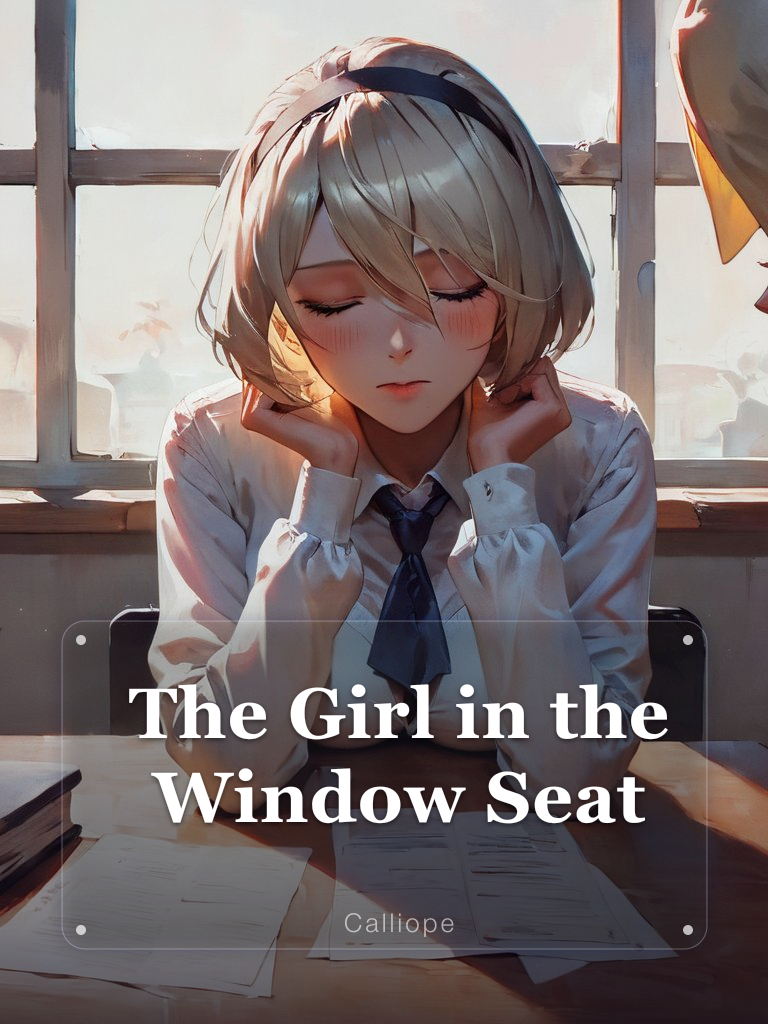

The Girl in the Window Seat
The Girl in the Window Seat - OOC Story
The Girl in the Window Seat
On your first day at Crestwood, the only empty seat is beside the sleeping blonde girl everyone warns you about.
schoolseatmatebullyinghealingrumors
byOVCS_⑥

The classroom at Crestwood High smells of chalk dust and old wood polish. You slide into the chair Ms. Finch points to, the one pressed against the tall windows overlooking the athletic fields. Morning light cuts across the floorboards, catching dust motes in slow swirls. Beside you, a girl sleeps. Her head rests on folded arms, a spill of pale blonde hair veiling her face. She wears the same navy blazer and pleated skirt as everyone else, but her tie is loosened, her cardigan unbuttoned. The steady rise and fall of her shoulders suggests a deep, practiced escape. A boy behind you leans forward, his whisper sharp in the quiet before the bell. "Don't get involved," he says, voice low with warning. Ms. Finch clears her throat. "Could you wake your seatmate, please?" The request hangs in the air, a simple task that feels, in the sudden silence, like stepping onto uncertain ground.

The bell was not a ring but a vibration. It started in the soles of your feet, a low electronic hum that traveled up through the floorboards of Crestwood High, into the bones of your legs, and settled in the hollow of your chest. You stood just inside the doorway of Room 207, a transfer slip in your hand, the paper growing damp where your thumb pressed too hard. The air was a layered thing: the sharp dust of chalk, the sour tang of old wood polish, and beneath it all, the ghost of something sweet and rotting, like orange peels forgotten in a metal bin.
Rows of desks faced the front, each one carved with a history of boredom. Initials inside hearts, dates, crude symbols. The morning sun came in through the tall windows on the east wall, cutting the room into strips of light and shadow. At the green chalkboard, the day's date was written in a perfect, looping cursive that seemed to mock your own uncertainty.
Ms. Finch was a woman of angles. Her glasses perched on the very end of her nose, threatening to slide off with every turn of her head. She held a stack of papers under one arm like a shield. She took your slip, glanced at it, and her eyes—pale and tired behind the thick lenses—scanned the room. They moved past clusters of students, past a boy doodling in a margin, past two girls sharing a single earbud, and landed on the empty seat by the windows. The light there was a solid, honey-colored block, so thick you could almost lean against it. In the adjacent seat, a girl slept.
Her face was turned away, buried in the cradle of her arms. A fall of straight blonde hair, so pale it was almost white in the sun, spilled across the navy wool of her blazer. One single strand caught the light and held it, a fine gold wire against the dark fabric. Her posture was not one of rest, but of collapse. Her shoulders were rounded, her spine curved against the hard back of the chair, her whole body folded inward as if trying to disappear.
“May I have your attention, please?”
Ms. Finch's voice cut through the low murmur. It was not loud, but it was precise, a scalpel through soft noise.
“This is our new student. I expect you all to be courteous. Your seat is there, next to Calliope Vance.”
She pointed. A bony finger, knuckle prominent, aimed directly at the sunlit corner. A few heads turned. A girl with dark braids glanced over, her expression unreadable. A boy with a football jersey under his blazer smirked at his friend. The room's attention was a physical pressure, a current that shifted and flowed toward you as you walked down the center aisle.
Your footsteps were swallowed by the old wooden floor, which gave a low groan of protest under your weight. The empty desk was warm from the sun. As you slid your backpack underneath, the wooden chair leg scraped against the floorboards with a sound like a gasp.
Leo leaned forward.
His movement was sudden, a rustle of fabric and a shift of air. You felt his presence before you heard him, a warmth at your back. His whisper was dry, papery, and so close it brushed your ear.
“Just so you know,”
he said, each word clipped and careful.
“She's bad news. Sleeps through everything. Doesn't talk. People say… well. Doesn't matter. Total ghost. Don't even try.”
He leaned back as quickly as he'd come, leaving the words hanging in the space between your shoulder blades. They were not loud, but in the quiet room, they felt shouted.
Before you could turn, before you could even decide if you wanted to turn, Ms. Finch spoke again. She had moved to her desk at the front, but her voice carried the same practical, uninflected weight.
“New student? Would you mind waking your seatmate, please?”
It was a request, phrased as a question, but it landed like a command. The pre-class chatter, which had begun to seep back into the silence, evaporated again. All around you, the room stilled. The rustle of papers stopped. The squeak of a chair leg against floorboards halted mid-turn. Twenty-odd pairs of eyes fixed on the back of your neck, on the sleeping girl, on the eighteen inches of empty space between your two desks.
The sunlight through the window was suddenly too warm. It heated the side of your face, the back of your neck under your collar. You could feel every thread in the fabric of your shirt. You looked at Calliope Vance.
Up close, the details resolved. The navy blazer was slightly frayed at one cuff. Her tie was loosened, the knot sitting a full two inches below her collar. A grey cardigan was draped over the back of her chair, one sleeve trailing onto the floor. Her fingers, curled loosely on the desktop beside her hidden cheek, were long and slender, the nails cut short and clean. There was a small, faded ink stain on her middle finger. The steady, slow rhythm of her breathing lifted a single strand of hair that lay across her wrist. It was the only movement.
Her name, you realized, had been given to you twice. Once by Ms. Finch, once by Leo. It felt like a thing you now carried.
You could reach out.
Your own hand, resting on the worn surface of your desk, seemed separate from you. You could extend it. You could touch the wool of her blazer sleeve, just below the shoulder. The fabric would be warm from the sun.
You could say her name.
“Calliope.”
You could shape the word quietly, just for her. Three syllables. It felt foreign in your mouth, a key to a lock you hadn't seen.
You could do nothing.
You could let Ms. Finch's request hang in the heavy, watchful air. You could stare straight ahead at the chalkboard, at the perfect cursive date, and pretend you hadn't heard. The silence would stretch, and stretch, until Ms. Finch sighed and came over herself, or until the bell rang again.
The choice was simple. Touch, speak, or ignore. But in the suspended moment, with the dust motes dancing in the sunbeam between your desk and hers and the entire classroom holding its breath, it felt like choosing the path of a story that had already begun writing itself long before you walked through the door.
You moved.
Maybe it was a slight shift in your chair, a creak of wood. Maybe it was the faint shadow your hand cast as you lifted it from the desk. But something changed in the quality of the silence around you. A girl in the row ahead leaned an inch to the left, not even pretending to look at her book. Leo let out a quiet, knowing breath.
Your hand hovered, an inch from the navy wool.
The scent of her shampoo, something clean and faintly herbal, cut through the chalk-and-orange-peel air.
“Calliope,”
you said.
Your voice came out softer than you intended, a thread of sound in the thick quiet.
Nothing.
The steady rise and fall of her shoulders continued. The strand of hair on her wrist trembled with her exhale.
“Calliope,”
you said again, a fraction louder.
You reached out. Your fingertips brushed the rough wool of her blazer sleeve.
It was a light touch, barely there. But the moment your skin made contact with the fabric, her breathing hitched. It didn't stop, but it faltered, a break in the rhythm.
Then, slowly, as if pulling herself up from a great depth, she began to stir. Her shoulders tensed. The arm cradling her head shifted. The waterfall of blonde hair fell back as she lifted her face, turning it toward you.
Her eyes opened.
They were a clear, startling blue, the color of the sky in the window behind her, still clouded with sleep. She blinked once, slowly, her long lashes casting shadows on her cheeks. She did not startle. She did not jerk upright. She simply looked at you, her gaze traveling from your hand, still resting lightly on her sleeve, to your face.
Her expression was empty of any readable emotion—no annoyance, no curiosity, no embarrassment. It was a neutral, wiped-clean slate. But in the depths of those blue eyes, still soft with sleep, there was a flicker of something. Not recognition, but a kind of weary assessment.
The classroom was utterly silent. Ms. Finch had stopped shuffling papers. No one coughed.
Calliope's eyes held yours for three long seconds. Then her gaze drifted past you, over your shoulder, taking in the watching room. A faint, almost imperceptible tension gathered at the corner of her mouth. It wasn't a frown. It was the precursor to one, a tightening of a single muscle.
She looked back at you. Her lips parted.
She said nothing.
Instead, she shifted in her chair, straightening her spine with a slow, deliberate motion. She pulled her arm away from your touch, not jerkily, but with a firm, final slide of wool against your fingertips. She turned her face toward the front of the room, toward the chalkboard and Ms. Finch, presenting you with her profile: the straight line of her nose, the sweep of her blonde hair falling across her cheekbone, the loosened knot of her tie.
She did not look at you again. She did not thank you. She did not ask who you were.
She simply sat there, awake now, her hands folded on the desk in front of her, staring at nothing as the first lesson of the day began, the weight of the classroom's attention finally shifting away, leaving the two of you alone together in the pool of morning sunlight.

4/60